PUNCH TO THE FACE

A punch to the face is what Mulligan sensei called a high affect encounter – jodan tsuki scares most people. Jodan and jodan tsuki are both covered in earlier posts.

This morning presented the classic Karate punch, meaning the fist is twisted at the final contact and the elbow is turned point out, forearm parallel to the ground. Martial artists will debate the specific variations and reasons for executing a punch with its myriad of variations –  learn those details, the details are critically important. Nevertheless the basic distinction today was the fist thumb down, fist parallel vs. the thumb up, fist perpendicular – shorthand labels: Karate vs Aikido.

karate punch.jpg
Classic Karate
its not a jab
Straight blast

Solo exercisejodan tsuki in place, then advancing across the mat, alternating L/R for bilateral development.

[Additional solo training follows a jodan, chudan, gedan pattern – the odd number count means you will be alternating L/R at each of the striking levels]

Partnered orientation – one partner strikes, the other slips advancing irimi sufficiently to avoid the strike but not deeply. The purpose is to inure each other to over-reacting to the punch. Train to condition a controlled action and overcome the flinch or startle response. Once the players can calmly assess an incoming strike and avoid being hit, then introduce indexing with both the front and back hand tap.

Intercepting hand – train to tap the incoming strike with either the front or back hand so as to assist the slip and simultaneously develop sensitivity and indexing. Sensitivity because the tap needs have sufficient power to prevent the strike from continuing to the target, but cannot be too strong that it changes the angle or adds energy to the strike. Indexing because by using both the front and back hand, the players are familiarizing themselves with all combinations: L/L, L/R. R/L, and R/R. (FMA gunting.)

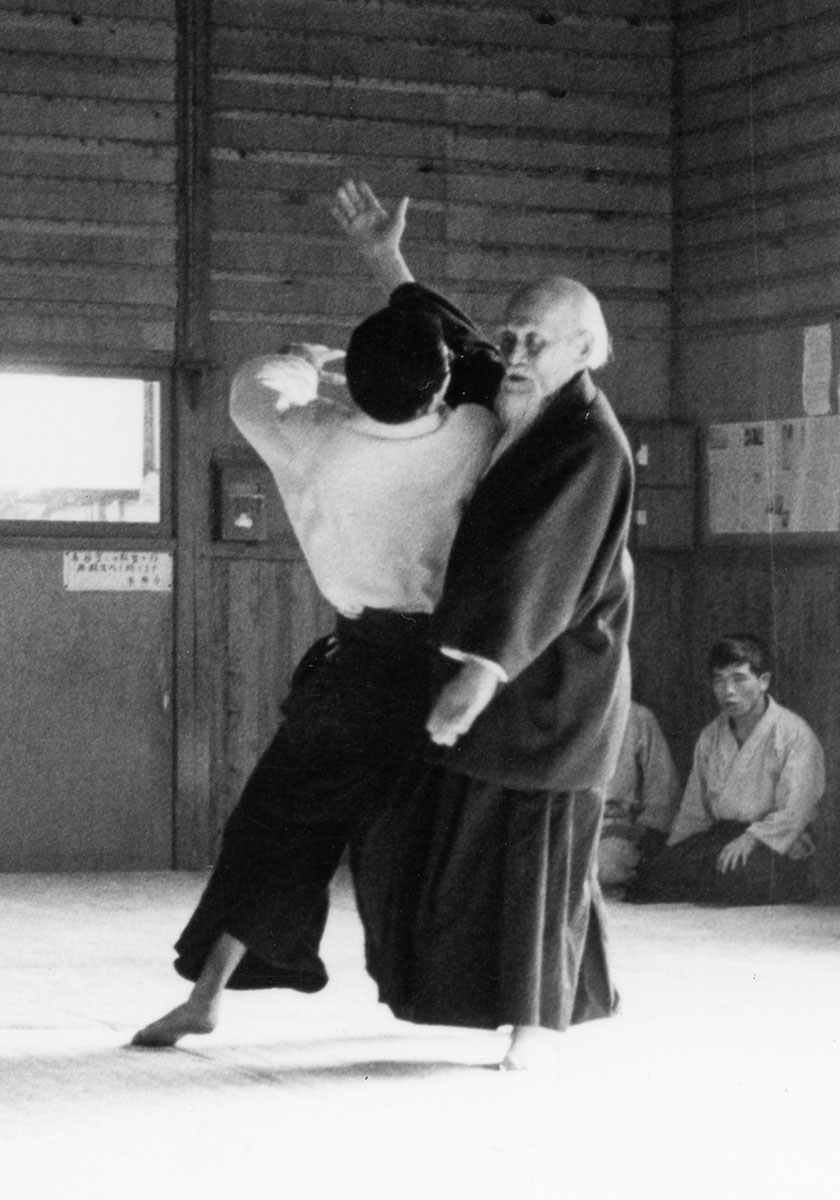
Ikkyo – because the Karate punch puts the elbow point out, the flow to ikkyo will feel slightly different. Emulate the grace and smooth entry demonstrated by Tissier sensei >here< to develop the connection Aikido aspires to focus on. From the punch, enter with a traditional back hand rising intercept while the front hand thrusts past to uke’s back.  Nage should be able to touch uke’s striking arm’s scapula and then with a wiping control take the triceps to control. The wiping action of the palm to the triceps while the back hand remains connected to the initial striking hand is makiotoshi. The action is on the outside line – meaning nage is entirely on the outside of uke’s striking arm. This morning I demonstrated the technique with a hip rotation (aka ura) but could just as readily presented a frontal entry (aka omote) but the distinction on how the lower body moves relative to uke does not change the dynamics of the upper body. The upper body executes the ‘technique’ whereas the lower body positions – hence there is no ura.

Irimi nage – by using the front hand to intercept the back hand rises to cut uke down irimi nage. Ikkyo is a back hand intercept. The rising intercept is akin to suriage or brushing action with the sword, but because both hands are free, nage’s front hand finds and taps uke’s fist which clears the path for nage’s back hand which will strike uke. This is a two-beat direct irimi-nage. From here we can explore the subtle variations. Blend with the hips sufficiently to lead uke forward to add connection in the hara to make the counter less ballistic (a simple response). Nage must drop the weight to break plane and drop uke’s center of balance. Nage’s back hand can now roll to present thumb (mune) down which now creates a one-beat encounter with the hands performing two actions in one beat.

Bunkai (1) – move to a three-beat: nage uses a front hand intercept and uses a back-knuckle (uraken) strike to the back of uke’s striking fist, then uses a back hand trap to keep the path clear for nage’s front hand to continue to irimi-nage. (FMA’s – de-fanging the snake because uke’s fist could always be loaded with a blade.)

anatomy upper arm

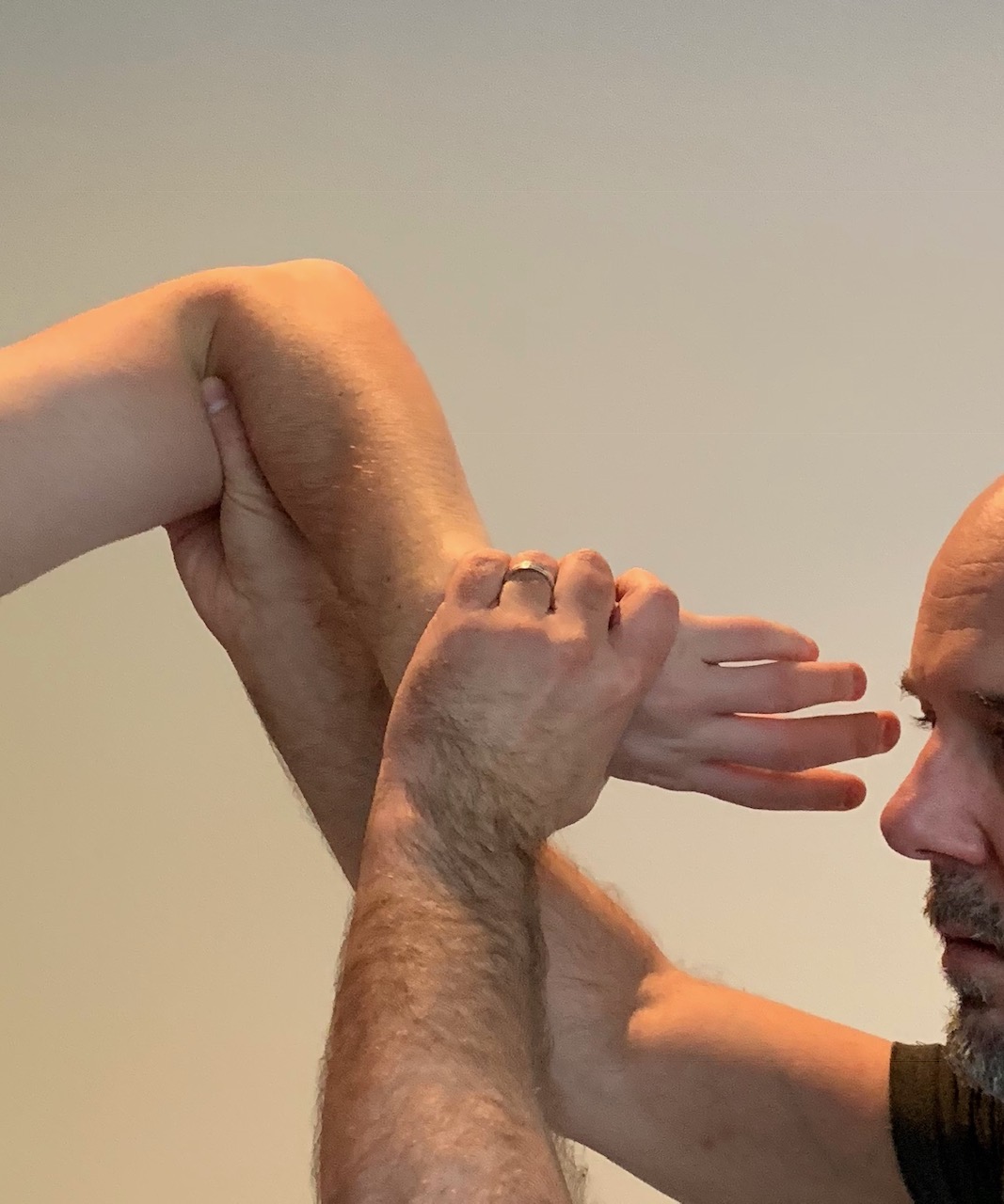
Bunkai (2) – staying with a three-beat, nage strike back of the attacking hand, then traps with the back hand and now rather than the initial front hand flowing to irimi-nage, nage folds his front arm to a downward elbow strike. FMA’s – hammer and anvil strike to the biceps. The combative application would use a rolling strike to drive the tip of nage’s elbow into uke’s median nerve and brachial artery, with Aikido’s emphasis on kimusubi, the strike becomes a connection point – the axis of the encounter – so that once the connection is made, nage shifts the balance point to the dead angle to break uke’s balance for the throw. What other arts would use as limb destruction, Aikido will use as a point of connection. But you must know how to properly target!

side choke.png

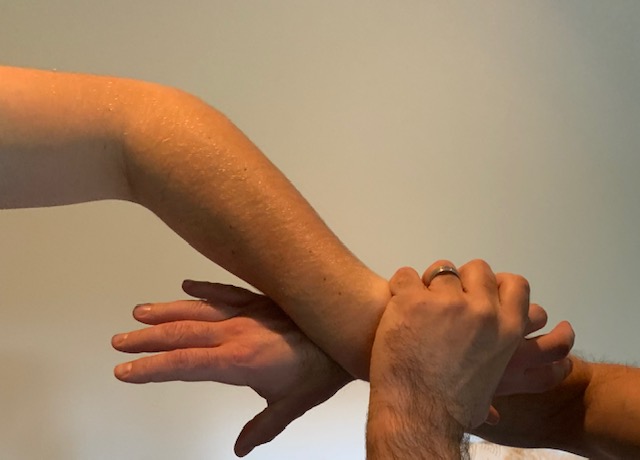
Split entry – thus far, ikkyo, irimi-nage, and the destabilization exercise are all approaches from the outside line. Next we moved to a split entry where nage kept one arm outside the striking hand and the other inside. As uke strikes, nage uses the front hand to shoot low to high whilst tapping uke’s strike with the back hand. This will direct uke’s strike just past the intended target and allow nage to trap the striking hand with the shoulder to throw irimi-nage direct. In the event the throw is ineffective, the fall back play is to then trap uke in a side choke. The side choke has the advantage of trapping uke’s striking hand and because nage’s radial bone will roll and compress uke’s neck and carotid artery, the choke is very effective. Be careful when training – avoid too vigorous applications and avoid the shearing action by rolling the forearm.

Gunting_0.jpg

Inside entry – we did not get to cover the inside line in the first class, but we did explore an option the following Monday with a variant of Yokomen uchi sumio toshi. To explain the concept with a familiar technique, the inside line is met like yokomen direct (where nage remains bodily on the interior of the strike because uke’s attack is oblique). Nage’s back hand receives while entering and the front hand intercepts the elbow for the standard sumio toshi, or if nage enters more deeply, then the front hand can take uke’s striking arm shoulder/neck for a more dramatic version. But as a concept, the Aikido shorthand for the inside entry is ashi-sabaki. The FMA application is a gunting using the front-hand back knuckle to the median nerve while tapping with the back hand to keep uke’s strike from landing.

The inside line is a direct entry – for the Aikidoist, the play concentrates on a connected re-direct of uke’s attack with nage’s forearm and uke’s humerus – the bodily entry will take uke’s balance offline. FMA/JKD will stay online to focus on the limb destruction and trapping entry. Very similar bio-mechanics but with a philosophical difference in approach. Steal from the masters because the other arts are instructional – teaching proper targeting and application.

Because these are concepts to explore, the inside/outside/split entry is a referencing tool: what opportunities are afforded to me when I am in this relationship with my partner? Therefore, these are not techniques, rather they are keys to understanding.  While this post discussed a highline straight attack (a punch to the face), every attack can be met on the inside, outside or with a split entry. Explore!

MIYAMOTO MUSASHI

In an interview, Nishio sensei unapologetically labeled Musashi as “the lowest form of human being.” Understandable. Nishio looked at how little human emotion and human engagement Musashi exhibited; he never married, never started a family, and spent a life dueling to test his skill and mettle. Musashi manifested a coward’s response, by developing skill from a fear-based approach to life: Life denying skill vs life affirming skill.

Nishio sensei’s is an easy conclusion to make, given that in The Book of Five Rings, Musashi admonishes:

Do not sleep under a roof. Carry no money or food. Go alone to places frightening to the common brand of men. Become a criminal of purpose. Be put in jail and extricate yourself by your own wisdom. [1]

Musashi rejects all the trammels of society and suggests breaking its laws to be put in jail. Why? History was not kind to him. Musashi fought on the losing side against Tokugawa Ieyasu whose Shogunate effectively unified the nation by destroying regional authority and power. He is a man who desperately clings to his martial prowess as the only valid means to define himself:

The only reason a warrior is alive is to fight, and the only reason a warrior fights is to win

Musashi is a warrior adrift, without purpose or cause to serve. So he turns inward to define himself:

There is nothing outside of yourself that can ever enable you to get better, stronger, richer, quicker, or smarter. Everything is within. Everything exists. Seek nothing outside of yourself

The external world is a testing ground, opponents are a means to an end (violating a Kantian imperative) to perfect his art.[2] But Musashi is perfecting the art of fighting during the Shogunate when violence is centralized to the state. He is a man out of time.[3]

Therefore, while I understand Nishio’s characterization, Musashi’s writings merit study. The Book of Five Rings are the reflections of a warrior who has refined the lessons of combat to principles.

When I reached thirty I looked back on my past. The previous victories were not due to my having mastered strategy. Perhaps it was natural ability, or the order of heaven, or that other schools’ strategy was inferior. After that I studied morning and evening searching for the principle, and came to realize the Way of strategy when I was fifty.

The Way of strategy is not a compendium of techniques. It is not a fechtbuch. Musashi is claiming to have discovered something more universal

The true science of martial arts means practicing them in such a way that they will be useful at any time, and to teach them in such a way that they will be useful in all things.

These maxims are easy to gloss over because they are concise and can seem perfunctory, or obvious:

If you wish to control others, first control yourself.

The problem is that we all too often forget these lessons, so Musashi shows us how to be mindful: A hyper-vigilance to external sensory information (Cooper) and to internal processing leading to sangfroid:

Both in fighting and in everyday life you should be determined though calm. Meet the situation without tenseness yet not recklessly, your spirit settled yet unbiased.

Control and calm in the midst of chaos is Mushin.

mushin.jpg
Mushin

Mushin: the term is shortened from the Zen principle, ‘Mushin no shin’ (無心の心). It refers to the state of ‘no-mindness,’ when the mind is not fixed, or cluttered by thoughts or emotion. How do we achieve the Way? First the grounding principle:

Do nothing that is of no use.[4]

Precisely! But it is brilliantly difficult to know when we are doing things that are of no use. It is all too easy to cede the responsibility of knowing what is of use to an authority – the teacher – and in the early stages of every journey we all need a guide. Musashi’s biography teaches us that pain and experience are great teachers.

And as important as learning, pain, and experience are, the highest key to understanding is meditative reflection:

It is difficult to realize the true Way just through sword-fencing. Know the smallest things and the biggest things, the shallowest things and the deepest things.

A poetic way of reminding us to think! When we practice a martial art it is all too easy to focus on the physical aspects of learning; how do I move my arm, what is the timing and sequence of operations, because these are necessary to learn. But we must learn to make the broader connections – among the movements and with our partners from the simple act of rotating (camming) your forearm. Moving your hand as if you are turning a door knob, a simple act we repeat many times a day, is camming, which is makiotoshi, which is ikkyo, and ikkyo solves for the infinite.  See the smallest things in the biggest things, the budo is not at the surface.  By seeking and seeing the connections we can,

From one thing, know ten thousand things.

There are not infinite techniques. There are only limited expressions of the body that can then generate a large number of responses in a large combination of encounters. I look at it like chess – a game played on a fixed matrix with a defined and small number of rules that generates an incredible number of combinations. Do not get blinded by mathematical possibilities! Not all possible moves are valuable. Thus, by knowing principles you can know all the responses you need. And because any given possibility must be instantiated to be real, you are only ever dealing with precisely one encounter and one response at a time. Each encounter also is with a person with their own limitations that we must exploit, therefore, Know the limitations of the body. But more critical is to know the limitations of the mind:

In battle, if you make your opponent flinch you have already won.

Musashi reminds us that we are playing an opponent, therefore mental combat is even more important than physical engagement. Musashi informs Bruce Lee’s later “Be like water” taken directly from the water section:

With water as the basis, the spirit becomes like water. Water adopts the shape of its receptacle, it is sometimes a trickle and sometimes a wild sea.

In the fire section, Musashi outlined three methods to forestall the enemy:

  1. Forestall by attacking
  2. Forestall by responding to his attack by feigning weakness, then attacking
  3. Forestall by attacking when he attacks and meeting him head on

Bruce Lee expanded these to the five methods of attack – which I covered in >this< earlier post. These lessons are explicit in many arts but not well-integrated in many Aikido dojos despite O’Sensei employing them (“Control the encounter before it is enjoined”), or;

In contests of strategy it is bad to be led about by the enemy. You must always be able to lead the enemy about.

Afterall, the distillation of combat is goal oriented: to win. And to win will often require an attack, which is a mind-set embodied physically:

When you decide to attack, keep calm and dash in quickly, forestalling the enemy…attack with a feeling of constantly crushing the enemy, from first to last.

Because Musashi wrote when violent encounters were likely and because he was a swordsman, the language of winning is combative. Combat is life, you cannot keep them separate:

In all forms of strategy, it is necessary to maintain the combat stance in everyday life and to make your everyday stance your combat stance.  You must research this well.

The Book of Five Rings enjoyed currency as a business text and I am sure it will continue to flux in and out of vogue. The point is winning does not necessitate violence red in tooth and claw but it does require decisive action. You cannot win by defending is perhaps the most important lesson for a martial artist who aspires to non-violence.

Which leads to my favorite conclusion for deep consideration:

No man is invincible, and therefore no man can fully understand that which would make him invincible.

_________________________

Resources

The Book of Five Rings

Searchable PDF The Book of Five Rings

Heiho of Musashi

Additional meditations on Musashi’s Book of Five Rings and >here<

Musashi with his bokken-oar

Visit Ganryu-jima – the uninhabited island where the duel between Musashi and Kojiro was fought.

___________________

[1] Note the similarities with Plutarch’s description of Spartan trainingagoge (ἀγωγή).

[2] Mark Manson on Kant.

[3] I wonder if The Book of Five Rings wasn’t a job interview in the same way Machiavelli wrote The Prince to ingratiate himself to the Medici.

[4] “Do nothing of no use” – O’Sensei echoed Musashi in his Secret Teachings of Budo, poem #29. “What use to learn this sword work or that! Cut off all thought of useless things.”

HUMAN FRAILTY

The human body has numerous design flaws. Poor eyesight (40% of Europeans and 75% of Asians need corrective lenses), an optic blind spot, choking remains a problem (air and food enter via the same tube), etc.; simply stated, humans could be better engineered. But our big brains and the division of labor allowed us to become the dominant species and because of social specialization we do not have to have a perfect body design.[1] 

A well-versed martial artist will use that big brain to study these design flaws to exploit weaknesses.

The following then is an exploration of how to exploit physiological weaknesses – a focus on bunkai or application rather than the flow (ki no nagare). Effortless control requires that nage understands how to exploit these design flaws first – concentrating on the stopping points in each technique before moving past ‘hitting the points’ to concentrate on the connections between the points.

Aikido teaches some basic nerve, muscle and bone manipulation – exploiting structural weaknesses. The bunkai or application of a coercive force is not emphasized but remains a critical skill to acquire.

Ikkyo.  At its essence ikkyo is a levered re-direct. The nuances have been discussed in earlier posts, but put simply ikkyo returns a vector of force back toward the assailant through better levers or superior time. The pin, however, is an attack on the elbow joint.  The simplest attack is to apply a shearing force against the elbow. As nage directs a downward force just above the elbow joint, nage then lifts on uke’s wrist – concentrating the opposing lines of force at the elbow. Given that we are playing with uke’s bones we will call this the skeletal level (bone locking). Ultimately nage would severely damage the elbow joint should uke fail to comply. A more subtle attack would be to compress the ligaments using the shyto (hand edge) against the area just at the ‘funny bone’ above the elbow joint. This pin can be executed one-handed by a skilled practitioner. It is a pain compliance technique and therefore not designed to cause permanent damage to ukeNage can also exploit a true pressure point control, by attacking the nerve complex (again at cavity above the elbow, or along the ulnar nerve against the humerus). The nerve attacks require the highest degree of precision and therefore are more difficult to achieve outside the training environment in the dojo. Again, nerve attacks will only result in a temporary loss of function.

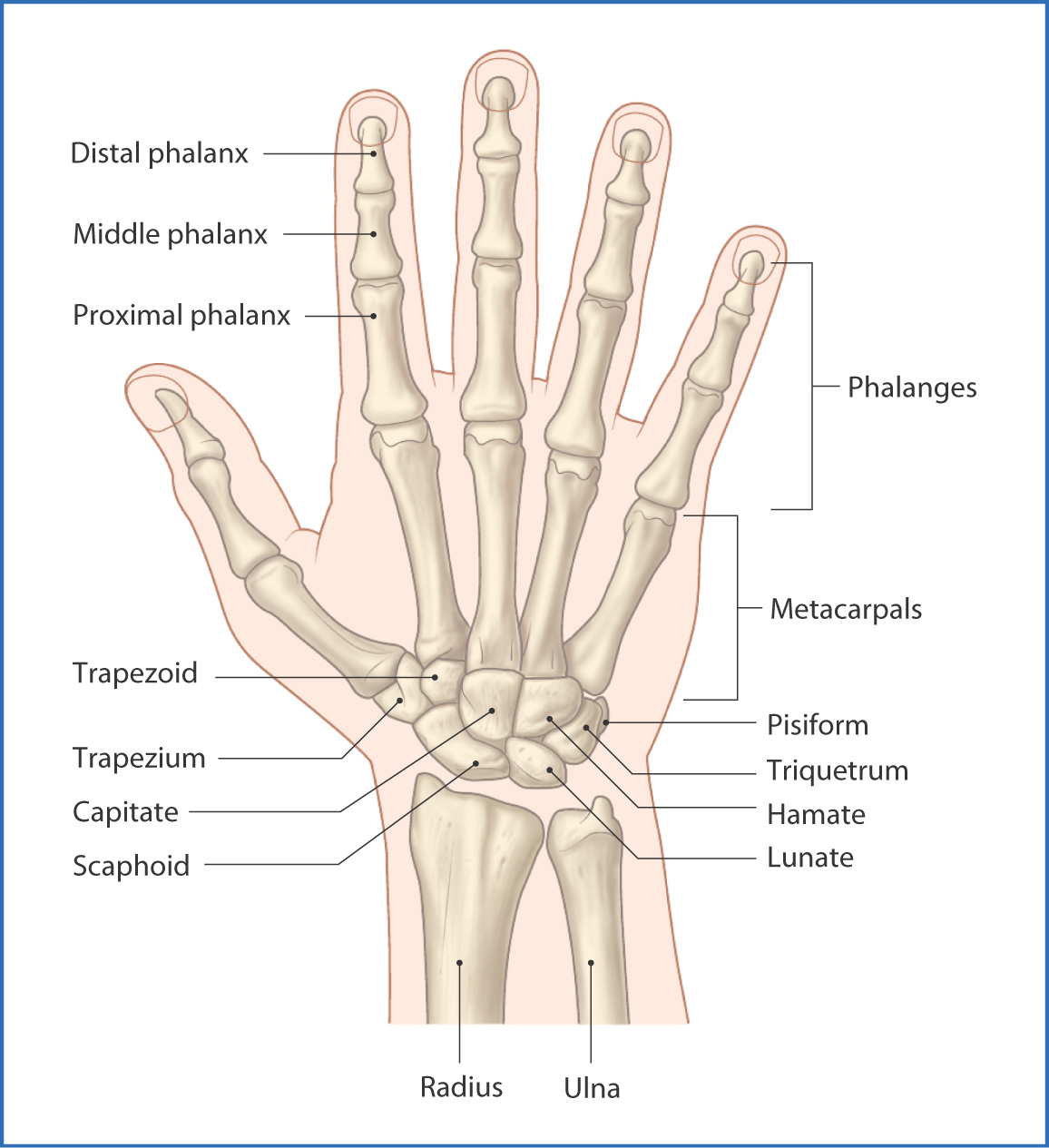
NikkyoNikkyo attacks the wrist joint. There are two primary variants on a wrist lock – the first where the wrist is bent 90-degrees (or more) before applying a rising force (i.e. through the thumb raising the little finger to the sky with rotational energy) or the second where the wrist is kept in line with the ulna so that the forces concentrate at the wrist but the entire forearm is used as a lever. (Understand the physiology of nikkyo and kote-gaeshi becomes nothing more than the anterior [uke’s palm up] application of nikkyo [uke’s palm down].) 

[An observational digression: kotegaeshi attacks the wrist along the lines it would normally bend. The converse line of attack is possible but not emphasized in Aikido because it requires controlling the fingers. When I was in high school, boys would test their mettle in a game of Mercy where we would interlace our fingers and force each other’s wrists backwards in a contest of strength and pain tolerance. Small circle jujutsu also exploits the smallest bones, but pain compliance or even breaking the finger joints is not sufficiently debilitating for battlefield efficacy. Working the distal joints to gain control of the larger joints is a great skill to master however, so do not ignore finger locks.]

Once the nikkyo control is established, then nage drives to the pin. The bunkai is a true driving dive to the ground: Having momentarily arrested uke, nage can then transition the hand controlling the elbow higher on the humerus to forcefully drive uke’s shoulder to the ground (to rupture the bursa or break the clavicle). Once uke’s shoulder is on the ground, the arm should be nearly perpendicular. The standing pin is a muscular attack – bracing uke’s arm in the vertical position with the leg, nage will bend uke’s wrist, fingers pointed down, and continue to exert pressure forcing the fingers down. A more sophistical approach would be to compress the index finger alone. The seated pin attacks the bones: with the shoulder joint firmly pressured to the ground, nage will compress and rotate the shoulder joint in an effort to grind and separate clavicle, scapula, humerus and acromioclavicular capsule.

Sankyo. Sankyo is a progressive attack – first establishing control at the fingers in order to then grasp the wrist lock in a continuous cork screw action that ultimately focuses on the tip of the elbow and then locks the shoulder (lock flow). I prefer the bunkai of sankyo as a knife strip or return, but as a joint lock the focus is on the spiraling energy directed through fingers, through the radius/ulna in order to lock the elbow. Continued application of force will then drive the elbow point forward and toward uke’s face, thereby moving uke backwards allowing humerus to lock the shoulder. Nage then cuts the tip of the elbow down to drive it into the ground. If uke preserves the elbow by dropping the shoulder first, then the elbow is hyperextended and nage can execute a pressure lock or break as the situation demands. This would be a standing bunkai. The controlling lock requires nage place uke’s palm on the knee to exert a twisting downward pressure into uke’s shoulder. The seated variant allows nage to apply body weight and additional range of rotation to further compromise the shoulder structure.  The grinding separation is the same vectors as nikkyo’s seated pin, nage just has the opposite hand on top. The force applied to uke is the same because we are attacking the same structural weakness.

I encourage the diligent student to continue this analysis and investigation. Yonkyo is an obvious nerve attack. Gokyo differs only mildly from ikkyo in concept and is a wrist destruction rather than an elbow destruction for its pin. Some will explain that gokyo is a knife defense, I would caution the astute student that all these techniques are weapon disarms so do not become blinded by didactic failures.

Some additional pointers to consider and explore:

Neck

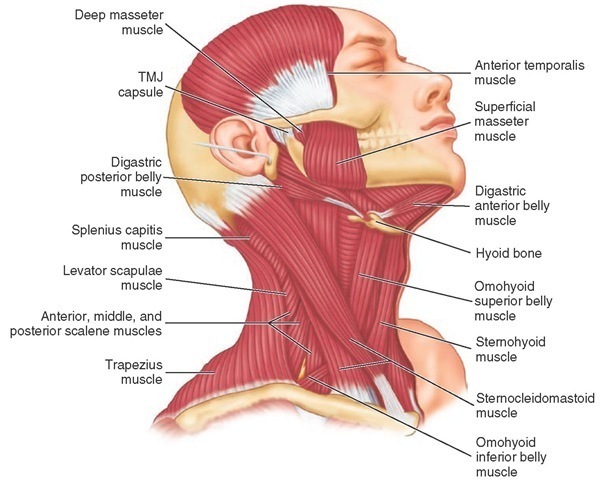
Irimi nage is clearly a skeletal / neck destruction, a manipulation of the mandible to rotate uke’s head. The more advanced entry requires a preceding control and muscular attack to the sternocleidomastoid or a nerve attack under the ear to the spinal accessory nerve to better gain control over the mandible.  If you cannot control the head, then the throwing arm can become a rear naked choke.

The need for corrective lenses is a reminder that human vision has other flaws to exploit. When delivering a straight thrust (jodan tsuki) the line of attack should be down to visual cone. Attacks delivered straight on are harder to see coming and leave less time for reaction. That’s because punches thrown straight at you are more difficult for your eyes and brain to recognize compared to a punch coming from the side. Our peripheral vision is attuned to pick up movement (rods vs cone concentration) and therefore oblique attacks are easier to spot.

In terms of your own offense the advantage here in throwing jabs and thrusts straight out from your chin and back. If the punch is in line with the eye it bypasses the motion detecting rods in your opponent’s peripheral vision making it much more difficult to detect. Learn to improve perceptual speed to overcome your own biological limitations.

While we can not always overcome biology (pain is a necessary to inform our bodies of danger)[2] by studying human vulnerability we can both better understand how to make a technique more effective (create a path of least resistance) as well as how to better gird ourselves against others exploiting the same flaws in us.

__________

[1] In the early 1980s Taiwan’s army realized it had a problem. More and more of its conscripts seemed to be short-sighted, meaning they needed glasses to focus on distant objects. “They were worried that if the worst happened [ie, an attack by China] their troops would be fighting at a disadvantage,” says Ian Morgan, who studies myopia at Australian National University, in Canberra. An island-wide study in 1983 confirmed that around 70% of Taiwanese school leavers needed glasses or contact lenses to see properly.

The Economist, June 9, 2022

The design of the human eye is an example of “good enough” but not smart engineering.

Because the nerve fibers coming from the rods and cones need to come together as the optic nerve, which then has to travel back to the brain, there needs to be a hole in the retina through which the optic nerve can travel. This hole creates a blind spot in each eye. Our brains compensate for this blind spot so that we normally do not perceive it—but it is there.

Novella, S. Suboptimal Optics: Vision Problems as Scars of Evolutionary History. Evo Edu Outreach 1, 493–497 (2008). https://doi.org/10.1007/s12052-008-0092-1

Cephalopods have a much better design – no exploitable blind spot!

An interesting and general consideration is the future of human evolution. Extrapolation from current trends does not bode well for the warrior of the future. See also >this< post.

Color blindness puzzles me. Why does red-green color blindness primarily impact men? Seems odd given that following a blood trail in the green woods is more difficult. I suffer from partial color blindness and can only see the “16” clearly and it takes effort for me to recognize the “7” while the other numbers are lost in the meaningless sea of dots.

[2] Tiger Man was one of Buck Rogers in the 25th Century greatest adversaries. In the television show he was invulnerable to pain because his nerves had been surgically removed. That impressed me as a great thing when I was a young man, just imagine feeling no pain! A more mature perspective shows how deadly that in fact would be: congenital analgesia is a life threatening condition.