UCHI KOMI

Uchi komi is an exercise whereby a clear opportunity to attack is presented to allow for repetitive and correct training to recognize an opening and to strike.

In Aikiken, the basic uchi komi exercise opens with both uchidachi and shidachi in seigan no kamaiUchidachi then lowers to gendan to invite shomen and when shidachi strikes, uchidachi receives by raising back to chudan level.  The footwork starts migi-hanmi, slide to receive on the first attack, then each successive attack is with a step: L-R-L-R, etc.

Uchi komi teaches spacing, timing and connection.  Spacing – uchidachi should start just outside simple range – from crossed kissaki, lower the sword to low guard and shidachi must still close to strike.  Shidachi should be focused on the cut – the kissaki to strike shomenUchidachi must first maintain proper spacing (maai) to avoid being cut, and then bring the sword from low-guard to mid-line (or just above) to receive (‘find’) shidachi’s blade and control the center-line.

The body sequence for shidachi is attack – weapon, body, foot.  Uchidachi is defense and therefore reverses the sequence, foot, body, weapon.  This is a foundational (basic) exercise and is described in developmental (not application) sequence.

Shidachi has a ‘simple’ lesson to learn: observe the opening, orient on the target, decide to hit, then act by striking.  Uchidachi must observe the strike, orient on space – retreat from the threat, decide to raise to guard, then act to find the blade.  Uchidachi’s OODA loop is steps behind – and purposefully remains there!  Typical strategy would be to interrupt the opponent’s loop to gain initiative, but uchikomi teaches a subtle lesson in timing and strategy: by creating the opening, uchidachi has directed shidachi to a specific target and therefore, uchidachi has seized the initiative before the action takes place (Attack By Drawing – ABD).  In western fencing – strategy is paramount – mental chess – the game is to ‘make your opponent put his chest on the point of your sword.’  Uchikomi properly understood teaches the same lesson.

How do we get there?  First a solid understanding of the biomechanics and physics.  Shidachi should develop a command of a direct overhead strike.  Easy to write, but not as simple to master.  Uchidachi must always be cognizant of proper distance to avoid being skewered with a tsuki yet be able to deliver a lethal strike.  Left hand is the power hand – right hand the guide hand – kissaki accelerating to the target area – free rotation from the shoulders, hands firm but not a death grip on the handle (‘like holding a bird, it cannot fly free, but you cannot crush it’), focused attention – all with a mindful awareness of the weapon – body – foot sequence and measure.  Uchikomi allows shidachi to practice this proper sequence repeatedly.

Uchidachi must time the sequence (kimusubi) in perfect measure – maintaining a half a beat delay in action to ensure shidachi maintains commitment.  Remember this timing difference is a bait, a draw.  The act of raising from gedan to chudan is adamantly not a beat but rather a finding of shidachi’s blade.  Uchidachi needs to connect and control the centerline.  The very geometry of the katana facilitates this dominance, for as the blade is raised, the ‘belly’ of the sword is rotated toward shidachi’s ken, thereby forcing the opponent’s sword just off-line while uchidachi’s kissaki takes the center.

When I learned the exercise from Mulligan sensei, he would do it with shoulders and wrists relaxed, the control was through a fluid transfer of power with the hips – the sword retained the centerline and the body moved to either side of the sword.  The primary focus was fluid motion – not catching the sword.

Shibata sensei taught it with a focus on the ‘capture.’  Once the blade is found, uchidachi would maintain a ‘sticky’ contact and then slide down to cut the tsuba with a determined ‘snap’ to emphasize the return to gedan with proper purpose.  This has the added benefit of making it very clear which side of the blade will be used next to receive since uchidachi’s blade will end clearly either to the R or L position.

Reviewing notes – a more stationary version of uchikomi is shown below:

ShbataKen
Variations

As shidachi strikes from an established maai, uchidachi remains ‘stationary’ (meaning the feet remain in their original position) but uchidachi uses a shinkokyu motion to remove his body as a target while bringing his sword from gedan to chudan but horizontal to the ground so that shidachi’s blade is captured at chudan level – having struck uchidachi’s ken perpendicularly.

From this structured position, uchidachi must take shidachi’s thumb with a spiral drop (maki otoshi) similar to the jo technique, but done only at chudan level and performed with the mechanical advantage of a lever but given power through the shinkokyu transfer through the legs.  The right hand is a ball joint and the left is used to manipulate the kissaki (direct and accelerate it) while the legs provide the power.   This exercise closes the distance, keeping both players in simple measure and forces a tighter connection.  As a global analogy – the absorption is like using the rope-a-dope strategy.

When the exercises are combined, then encounter becomes full – in movement, uchidachi initiates the sequence (and dictates the attack!) by giving gedan, thereby opening his highline as a target.  Shidachi attacks vigorously, and uchidachi responds by simultaneously finding the ken, deflecting its line, and cutting shidachi’s thumb and taking chudan tsuki.  Reaction is faster than action?  No – uchidachi was inside shidachi’s OODA loop from the first moment.  The encounter was won before the engagement was made.  No mysticism – just good tactics and biomechanics.  The goal is to make shidachi put his thumb under your blade.  This is a quick encounter – similar in spirit to kiri-otoshi which is played at jo-dan level.  Uchi-komi is delivered on the rising line, kiri-otoshi on the descending line – but the deflection/dominance is the same just on inverse lines of approach.

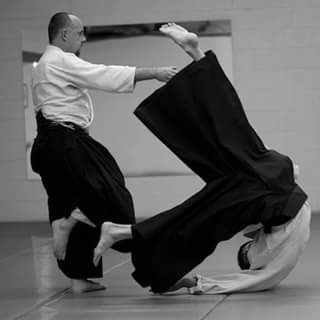
Done empty-handed, this is ai-hanmi katate-dori ikkyo done without foot movement – just the snap of the hips.  Alternatively you could produce it ‘old school’ by replicating/emulating Chiba sensei in the early 90s when the emphasis was to draw uke in with the grasped hand’s palm coming flat to nage’s chest as nage circled in and forward before delivering the counter stroke to ikkyo – the hips coil like a watch-spring before releasing the potential energy.  It is a close-quarter exercise, one designed for tanren-geiko – body development.  Explore these training methods.  There are important nuances to (re)discover – variations on how the shyuto is used (out, over, flat) but the fundamental movement and use of the body is the same.  Know why the subtleties matter, but do not become overly concerned with ‘which is more correct.’  They all are important in order to have the skills to deploy in the moment when circumstances dictate.

(RE)FRAMING AIKIDO

ShibataNotes.jpg
Notes after Shibata sensei seminar, 2007

Imitation may be the highest form of flattery but it is also a great way to learn. The monkey-see, monkey-do teaching combined with an interpretive gloss is how most of us are taught. Add physical manipulation and now you have a training method.

In the Western tradition, the burden is on the teacher, even when done Socratically, to lead the students to a conclusion. Pedagogy: a pedagogue, from Greek paidagogos ‘the slave who leads to class.’ However, I was taught in true Japanese spirit when we were lectured to ‘steal’ techniques; meaning the burden was on the student to actively take information. This requires a higher level of agency in learning – an expectation of active engagement, not passive consumption. The older I get, the more that I am convinced the ‘truth’ lies somewhere in the middle – ‘students’ need to have a high degree of agency, but the ‘teacher’ can certainly facilitate the transmission of knowledge.

Perhaps I am proving myself to be a luddite, but as useful as online videos are, they are not conducive to imprinting information. They are wonderful in providing visual reminders – a historical record – a moving library, but consuming videos is not sufficient to making the art your own. To do that, I contend, one must be more active. Consider, the act of making notes, to physically write or draw something to memorialize the movement forces you to re-present the concepts in a different media and therefore you must re-conceptualize the technique. To ‘write it down’ forces you to segment, to try to distinguish important components, to deconstruct essential movements.

You will never exhaust your understanding of a technique because each time you focus on it, something new should reveal itself. I found an old note to myself:

“Observation / postulate – if there isn’t a clear narrative structure to presenting a technique, then it most likely is wrong.  Aikido is a story of an interaction.”

Given that I wrote that after a seminar with Shibata sensei, I know it wasn’t inspired by some insipidly saccharine sentiment. (It may have been the very seminar when I remember him opining, “The purpose of Aikido is to kill.”)

Shibata
The purpose of Aikido is to kill

I was reminding myself that without clear context every technique is mere movement – devoid of any meaning.  Movements in a martial art must be doing purposeful actions otherwise they are wasted energy. A mathematical analogy is that the solution must be elegant – one can use brute computational force, but that lacks efficiency and style. All too often a martial art can gain embellished movement, extraneous parts that may add flourish, but are nothing more than tales told by idiots (yes, Macbeth, Act 5 Scene 5).

How do you know a movement has meaning? Answer, what are you targeting? If you are not gaining position, moving to a vital target or limiting your opponent’s options you are probably wasting time and energy. Efficient motion. Good biomechanics. Or as I suggested above, tell the story of the interaction – who, what, why, where, when. Basic format. Who initiated? What were they doing? Why did they do what they did? Where were they intending to hit? When (at what speed) were they approaching? All the variables and agencies should be clear to you. If you cannot re-frame [1] the story, then it isn’t clear for you.

Thus the suggestion to write it down. Re-frame the experience by translating it into a new media. Take notes, draw pictures, make new connections to external metaphors.  Make it your own.

YamadaNotes.jpg
Notes after Yamada sensei seminar – Kitsap Aikido, 2007

Try to mimic a teacher’s particular style – parody it even – you may find a new or useful spark you did not expect to discover.

This entire website is an extended meditation on learning and conveying Aikido – first by how I was taught/learned but increasingly on how I have re-framed it for myself to better understand universals: to deduce and distill principles. Let us be clear – these are idiosyncratic descriptions but I hope that they may foster new connections for you also.

ShbataKen.jpg
Notes taken after Chiba sensei seminar circa 2000

Mulligan sensei once made a pithy observation that some people train for years but only ever train the same day. Meaning they fail to make connections and learn – every time they step on the mat it is the same experience, they don’t grow. And if you ain’t growing, you’re dying.

In his day job, Mulligan sensei taught English as a second language (ESL) and knew Chomsky, deep structure, and fluency acquisition and applied that as a metaphor for learning Aikido. You need to learn grammar for linguistic structure but the goal is fluency: Know the rules and break them like a native speaker. Learn the kihon and the precise movements in order to find the future freedom of expression in dynamic application.

MaxNotes.jpg
Max Kalkstein, Myofu-An Dojo

Hence my quoting him in an earlier post that “Aikido should be generative” – he meant that with a linguist’s understanding of the term. I agree.

Learning different languages can open deeper understanding of our mother tongue. Again, metaphors increasing connections – studying other martial arts should deepen your understanding of your own. But you need that foundational art.

Look back to Bruce Lee. Read his notebooks! His core art was Wing Chun, but look to his constant research to see how he made new connections. Generative grammar indeed!

Review the material I am (re)presenting. The influences are clearly enumerated and these posts an exegesis. Ultimately you should not agree with everything you read here but I hope you find something of value or new doors to open.[2]

____________________________

Notes from Hombu circa 1994

H1
H4.JPG
H3.JPG
H2.JPG

__________________________________________

[1] Re-framing. For me, the idea of re-framing is predicated on a sociological understanding, but one informed by Mikhail Bakhtin’s polyphony: combining here to mean that we should be studying widely to make connections and develop a re-presentation of our art (if only to ourselves) based on an appreciation for multiple perspectives. Note, this does not mean all perspectives are of equal value. They most definitely are not! I enjoy reading Marxist-influenced authors like Foucault, Bahktin, Bourdieu, but ultimately judge them incorrect. In a similar manner, I don’t think every martial art is of equal value, but I find valuable elements in all the arts I dabble in.

[2] Doors. Mulligan sensei is a music aficionado who can cite band membership, lyrics, and song tiles from any classical rock album. So pay homage and know where the Doors took their inspiration. And remember that Huxley riffed William Blake’s The Marriage of Heaven and Hell – “If the doors of perception were cleansed, everything would appear to man as it is, infinite” – to get his title. Bahktin’s intertextuality….

LINEAGE AND LEGACY

Knowing the heritage and the history of your art is important. We are not so far removed from the origins of the art. O’Sensei (Morihei Ueshiba) had a direct influence on several of the shihans still teaching today, and his son (the second Doshu) was still teaching when I trained in Japan. All of us have a direct connection to the very foundation of the art.[1]

A good ‘info graphic’ produced by Aikido Journal shows the lineage.

Aikido Chronology

Updated version >here<

Having a direct connection to the foundation provides an emotional continuity – we are part of the living history of the art.

The specific teachers who form the core influences of Portland Aikikai’s >Aikido Lineage< but the list is not exhaustive. For example, when Mulligan sensei first arrived in Japan he studied with several other instructors before moving to the Hombu dojo, where he met Yoko Okamoto. When Mulligan and Okamoto sensei moved to Portland they taught (with several other instructors) at Two Rivers Aikikai before a core group of seven students convinced them to form their own dojo in 1992.

IMG_0218.jpg
Ty and “Little” Scott 1992

The founding seven students were Rowan de Santis, Michael Cavalle, Andre Ngyuen, Scott Schanaker, Scott Margraf, Steve Shane, and myself.  Before we found the Marshall Street location, we rented the gym at the French American School.

French American
French American School

Because it was just a gymnasium, we had to roll out the wrestling mats every morning before class, which was a challenge given the large mat and small class size. Especially the morning class.  Okamoto sensei taught the morning class and would pointedly say “see you in the morning” to ensure attendance. In those early years, Scott Schanaker (“Big Scott”) and Scott Margraf (“Little Scott”) were regulars. Both were ex-military and specifically former special forces and both brought a sense of skeptical practicality to the mat. Art was fine but it had to be functional.

One of the earliest events we had the privilege to help with was the American Japan Week Budo demonstrations. Although we were there to help with organization for several of the arts, we had the deepest connection with the Aikidoka.

Budo week
1992

Okumura Sensei (9th Dan) brought Yokota Sensei and Sugawara Sensei along with three other students for the demonstration. If my memory serves, Okumura sensei was the first visiting shihan to give a seminar at Portland Aikikai.

Okumura 1992.jpg
Ty, Scott Margraf, Okumura and Mulligan Sensei 1992
Yamada sensei
Yasuno sensei seminar
Chris M 2 2008


Chris Mulligan

Looking back, Mulligan sensei – the teacher by training – always provided the pedagogical structure with a blunt rhetorical style and very physical approach to training. In those formative years of the dojo, the attrition rate was higher because of the training methods. (I recall – and should probably demonstrate more – the very effective bunkai for uchi-kaiten-nage Mulligan sensei used then…) Okamoto sensei was a constant training presence when she wasn’t teaching and taught primarily by-doing rather than by-saying. In part it was her lack of comfort with English, but I am sure the larger reason was a philosophical approach to teaching. Watch and learn! But make sure to train! They had both arrived in America as yondan but actively sought out further guidance for development.

1994.jpg
Portland Aikikai 1994

We traveled to Seattle to train with Bruce Bookman in order to learn further learn Chiba sensei‘s newly developed sansho

Bookman.jpg
Bruce Bookman Sensei circa 1994

Chiba sensei was introducing his jyo series to the broader community in a seminar format.

Learning Sansho.jpg
Learning sansho

Chiba Sensei was frequently in Ashland at Bluhm Sensei’s dojo and Shibata Sensei was invited to Portland.

Bluhm and Steve
Bluhm Sensei practicing sansho with Steve Shane circa 1996

Despite our affiliation with Yamada sensei, because of geographic proximity and stylistic

yamada horizontal power.jpg
Yamada Sensei’s horizontal power

similarity, we followed a very Birankai style.[2]

In addition to the more easily accessible teachers, because both Okamoto and Mulligan sensei retained excellent and close connections to Hombu Dojo, Portland Aikikai hosted several shihan from Japan.

Seijuro Masuda Sensei, Osawa Sensei and Yasuno Sensei in addition to several visits from Boyet Sensei.

Masuda.jpg
Masuda Sensei with Leslie Peterson
Boyet shoulder
You should have taken better ukeme…

Training during these years was physical – both demanding and expansive. The movements were ‘large’ because the art was being pound into us ‘like mochi being made.’ Simply look at Chiba sensei’s test requirements from that era.[3]

Of the original seven, only Michael Cavalle, Steve Shane, and I continued to train regularly over the next decade. Rick Watson joined the dojo upon his return to the USA from Japan, where he had trained at Hombu and followed Endo Sensei.

Since leaving Portland and founding Aikido Kyoto, Mulligan and Okamoto sensei have continued to grow their Aikido. Their Aikido has become more refined and grows closer to Tissier’s [4] and ultimately Yamaguchi sensei’s in style and approach.

This image has an empty alt attribute; its file name is yoko-yasuno.jpg
Yasuno

In some ways it is unfortunate that the raw development of the art is hidden by years of polish. I remember the imperfections, the fragility of understanding, the excitement of discovery through experimentation, the honesty in learning. All of the best aspects of beginner’s mind.

Shoshin – the beginner’s mind where possibilities are endless because everything is new. That feeling was easier to manifest because we were all constantly researching and discovering – not just simply teaching (transmitting) and learning (receiving).[5]

shoshin
Shoshin

Mischa Mulligan

When Chris and Yoko returned to Japan in 2003, Portland Aikikai had a strong cohort of senior students and we held the core for a decade, but always with a strong commitment of trying to be true to the legacy of our teachers.

dojo photo.JPG
Legacy Dojo

But there is a danger in having such a close connection with your teachers – their impact can be too deep.

This year represents the 25th Anniversary of Portland Aikikai. As such it should be celebrated – a continuous commitment to excellent training in Aikido – and we were excited to have Mulligan and Okamoto sensei return to join us. However, because there was not clear and easy communication among the participating dojos, they elected to cancel their trip. Setting emotional responses aside, Okamoto sensei ended her cancellation missive with a poignant reminder:

“I love visiting Portland. I have great training in Portland. Portland Aikikai is not Chris and Yoko’s legacy. It is your Dojo. I decide to not visit your Dojo this time because my visit will continue to give you wrong reason to practice Aikido.”

I found it ironic to read that message since it echoed one that I have said to others – that Aikido is too often a cult of personality. Our direct connection to a lineage of brilliant practitioners is a powerful resource, but ironically, a limitation on growth. I freely admit that for the past 12 or more years I had viewed my role more as a seneschal, a curator, for the dojo and not as its ‘dojo-cho.’

This image has an empty alt attribute; its file name is steve-ty-alex-yoko.jpg
Steve Shane, Ty Barker, Alex Ballard, Yoko Okamoto

Although I have owned the ProtectiveArts domain for well over a decade, it was only recently that I actually developed the website and started populating it with class notes from early 2016. I recognize that it has been a slow separation from the legacy of my own instructors. And looking at the closing paragraph I recognize they remain teachers still – but it is Your Dojo.

Ty, Yoko, Mallory

____________________

POST SCRIPT

1623 NW Marshall was home to the Portland Aikikai dojo for over twenty five years.  That ended effective April 2018 but that move resulted in a new location and a renewed dedication to the students and commitment to the art of Aikido.

1612 NW 15th – like writing the wrong date on a check after the new year, I wonder how many times I will reflexively drive to the old address before habituating to the new one.

When Mulligan and Okamoto sensei found the Marshall Street dojo I couldn’t see their vision. The clearstory windows were covered so there was little natural light. The warehouse was chock-a-block with boxes and cluttered with walls we would soon demolish to reveal a space with high ceilings and unobstructed by columns. A perfect space to transform into a dojo.

We moved the old wrestling mat from the French American School but that was soon replaced with a composite mat with a 2×4 frame, rubber dust, sandwiched with carpet and plastic and covered with canvas. A sail maker created the canvas cover and we cinched it down with rope through well-engineered eyelets.

Scott Schanaker made the kamiza – trimmed in purple heart wood. Bob Topping made the restrooms. Over time came other refinements: Craig Capistran made the shoe racks and the new frame when we added the tatami mats. It was a great location, but ultimately it is just a place.

And now you have all found a new space, a new dojo. I hope that this new location generates as many memories and fosters a healthy training community that lasts another quarter century!

_______________________________________

[1] Degrees of connection to the Founder: a lineage of course gives primacy to both degrees of separation and also the directness of the connection.  In mathematics, one can have an Erdős Number, the masses play Six Degrees of Kevin Bacon, and Aikido we could develop an O’Sensei number. Rather than a simple mapping of leaps, an O’Sensei number should be more like mapping consanguinity to show the depth as well as range of separation.

[2] Birankai was not officially an organization until 2000. Prior to that the United States Aikido Federation divided the USA into regional fiefdoms each with its appropriate daimyo.

[3] Chiba sensei demonstrating his 5th to 1st kyu test requirements is an invaluable resource for your video library.

[4] Tissier sensei – his biography and influences. Importantly his perspective on the future of Aikido.

[5] Shoshin – as explained by Chiba sensei.  His final thoughts on Aikido.

1992