AIKIKEN AND THE AXIS

This (1/25/25) was the first class after the end of Kangeiko and after Okamoto sensei’s visit to Portland Aikikai. It was *scolding-look* a lightly attended class.

Favorably, lower attendance provides a forum to explain the principle of the axis of an encounter using a weapon.

The first explication: shomen-uchi from the draw to irimi-nage.

Both ukedachi and shidachi face one another with swords in the saya.

Ukedachi draws first and cuts shomen uchi.

Shidachi draws second and meets the ukedachi’s descending blade to adhere to it and ride the momentum to the bottom of the stroke while moving irimi to ukedachi’s shikaku. The moment the two swords meet is the axis of the encounter and should be the point of the arc of ukedachi’s sword at maximum extension. This is the neutral point where shidachi can move toward ukedachi’s flank because the swords define the vertical arc of danger. The weapons provide a visual and physical barrier that shidachi solves for by allowing his sword to shield (not block) ukedachi’s strike and afford a path of safety to ukedachi’s dead angle.

The mechanics of the draw requires precise use of the body – lowering the center while the left hand pulls the saya back and the right hand is fed the handle to then continuously draw to the top of the arc and simultaneously cut – and is a skill that must be developed. Aikido’s empty hand strike shomen should replicate the subtlety of an iaido draw. We did not have time to fully explore the draw, but rather, focused on the moment when the blades adhere, and then follow to the culmination of the arc of movement. At the bottom on the cut, shidachi’s blade is on top of ukedachi’s and therefore is in a tactically superior position – ready to ride to the opponent’s throat. The threat of the cut is precisely the same as the use of the shyuto in ai-hanmi katate dori irimi nage.

Both players should have a natural extension of their arms to keep the sword alive – full of the potential for action. The quality of connection should be obvious with a weapon in hand – each player should sense the vibrancy, a light tension where the downward pressure of shidachi’s blade holds ukedachi’s upward action. From this moment, shidachi embodies the principle of katsujinken to ride ukedachi’s blade with the mune (false edge) leading toward ukedachi’s neck only to then pass it and turn the kissaki down – live edge out – replicating the empty-hand irimi-nage throw. The bunkai should be obvious. Should shidachi turn the live edge in, the cut is lethal.

Once the basic form is understood clearly, then the focus shifts to the terminus of the cut. The swords ride to the bottom and remain in active connection, this is an extension of the axis of action away from the limits of the body – the connection has moved to the weapons themselves. This should be a familiar concept. When we drive, the car becomes an extension of ourselves in a similar manner. We learn to know when the front bumper is danger-close to an obstacle. The extension of “ourselves” is the boundaries of our vehicle. So the extension of self through a weapon should be as prosaic as driving. Thus at the bottom of the cut, when the swords ride upon each other, shidachi should be able to sense an active connection back to ukedachi’s center.

Weapon work should make the reason for connection explicit. If ukedachi drops his sword tip and breaks connection, shidachi can freely cut to the neck. Only an active and extended connection affords ukedachi any semblance of hope for survival. Using the active connection, shidachi can play with pressure to destabilize ukedachi just like irimi-nage. That was the somatic similarity I tried to draw out, to make Okamoto sensei’s use of the shyuto more obvious and emphasize the need and reason for active connection. Weapons make clear what is only implied in taijutsu.

The next explication: morote-dori kokyu ho.

Nage is armed, but the sword is in the saya. Uke approaches to control nage’s weapon hand. Sensing the hostile action, nage presents the arm forcing uke to grab at the top of an arc, allowing nage to lead uke’s energy down while nage moves offline (approximately 33-degrees). This is the same position Okamoto sensei use for gyaky-hanmi encounters. The importance of this initial movement cannot be understated because it defines the axis of the encounter. Nage’s hand flows vertically down the axis while uke cuts, thinking there is the possibility of controlling the arm. Nage’s hand must be knuckles toward the inside of their own lead leg. Nage: do not drop your head or bend at the waist! Back is straight, the hand on the saya lifts it skyward, pushing the handle down into the grasped hand, and simultaneously turns the saya blade down while drawing it back and nage shifts bodily back, allowing the grasped hand to grab the handle in order to draw simultaneously. A complex sequence of events that must be done smoothly to execute a clean draw of the blade. Once free of the saya, the blade arcs out and up so that nage’s arm is softly but fully extended. Nage follows the draw with the back foot in order to then pivot and cut. The result will be kokyu-ho because the blade bypasses uke’s neck (extends beyond it, because nage moves in, rather than steps back – which would result in uke’s death).

The specific lesson is that nage moves around the original axis, and minimizes the horizontal movement of the grabbed arm. To accomplish this, nage’s shoulders must be held softly and the elbow must never fold – resist the use of the bicep!

Wielding a weapon should increase the seriousness of training and lead to a better understanding of the principles informing the empty-hand (taijutsu) techniques.
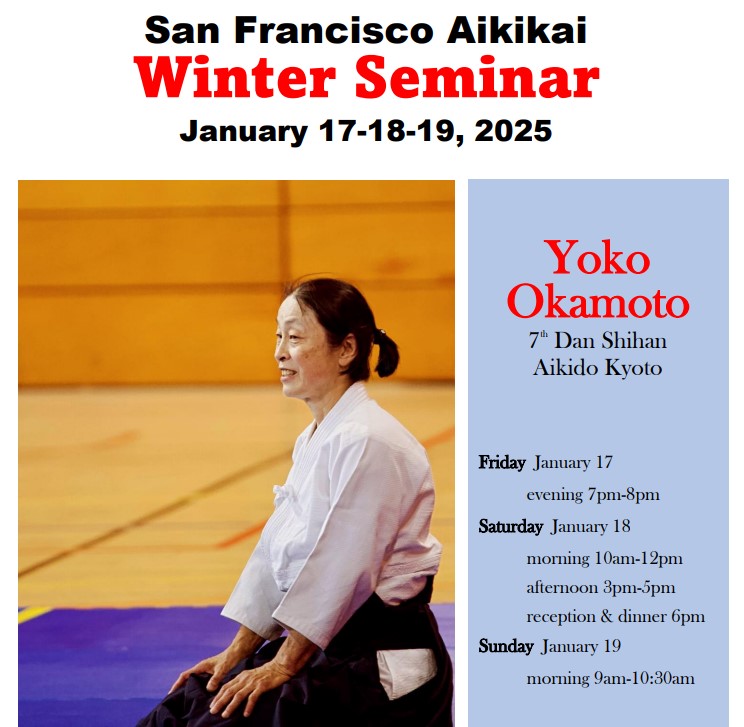
OKAMOTO SHIHAN SEMINAR 2025

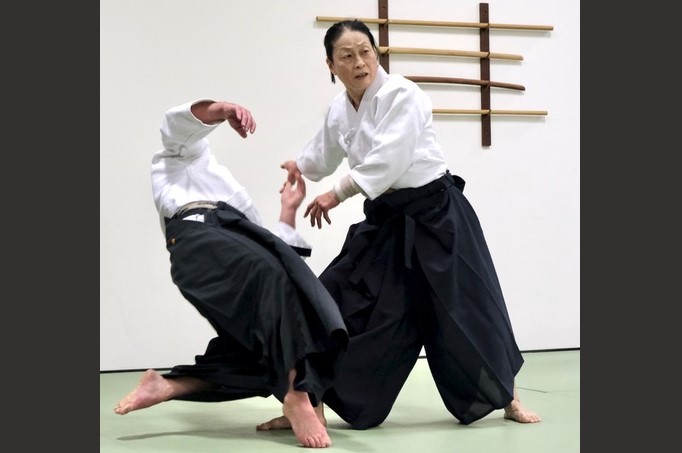
Okamoto sensei was in San Francisco for the January seminar which, historically, was the time Yamada sensei made his annual visit. It was a well-attended seminar with instructors from Mexico City and Montreal in attendance.

Mike Napoli, Russ Gorman, Oscar Johnson and I represented Portland Aikikai.

Okamoto sensei focused on connection and presented very few techniques – showing just gyaku and morote dori kokyu-ho, ai-hanmi katate-dori and shomen-uchi irimi-nage, ikkyo and shihonage.

Connection is challenging to establish, so she presented most of the exercises from a static grab in order to draw out a balanced commitment to the encounters. Starting from static eliminates the complication of timing and enhances the ability to work on appropriate responses from uke.

She was critical of hyper-responsive ukeme ukeme where uke exaggerated the movement which nage was impelling. She did not explain in thus, but the difference she was driving to is the difference between a reflex, a choreographed (trained) response, and a correct response. (I have called exaggerated ukeme an artifact of training.) The levels of understanding are reflective of the shu/ha/ri levels of training. A reflexive response is precisely what most martial art techniques rely upon – essentially a technique is a trick that exploits a reflexive response. In the dojo we quickly replace reflexive techniques with a trained response by teaching what is essentially choreography. Unfortunately, humans like drama, and dramatic ukeme is visually compelling. Most people enjoy the exaggerated responses precisely because the movements are large, easily seen and exciting.

Okamoto sensei tried to tone-down the responses in order to draw out a correct response. Equal energetic response based on input from nage and the corresponding output from uke. She used the example of two people hands together leaning into one another to demonstrate the principle. Nage does not pull uke and uke cannot lean upon nage. Neither party should be reliant upon the other for the structure of the encounter.

Which leads to the concept of “axis.” While nage must remain centered about his own axis – the line from the center of the head, through the core, and between the distributed weight of the legs – and has the goal of disrupting uke’s axis (balance and, specifically, spinal alignment), the primary way Okamoto uses the term is to describe the axis of the encounter, which is the moment of the initial encounter between nage and uke. This is the most interesting point in time because it is pregnant with possibilities.

Starting from gyaku hanmi, Okamoto sensei demonstrated two potential response, a full blend (tenkan) and a driving re-direct (irimi). Both and either should be available from the first moment of contact and nage needs to learn how to determine which is necessary from the moment of first touch. Sensitivity to uke’s grab and energetic input drives the possibilities, not nage’s expectations of a result. However, for Aikdo training to be productive, uke must present a genuine intention – provide an input that is combatively viable.

Therefore, Okamoto sensei reminded us that a grab must have a vector that is toward nage’s center with a goal to control the grabbed arm. Too much pressure in any other vector and nage should simply escape and riposte. She physically demonstrated this by slapping, or hitting ukes who were out of position or over-zealous with an imbalanced attack. I have shown this by using rebouding strikes and half-beats, and arts like Kenpo explicitly use them to advantage.

Critically, the balanced approach to the initial encounter among nage and uke is what defines the axis of the encounter. This axis is what nage must move around with minimal disruptive movement so as not to disturb uke’s initial intention. With a more combat-efficacious description, nage must not telegraph their intent so the initial grab is the point suspended in space as “bait” while nage moves to a tactically superior position.

Shihonage provides a difficult, but clear example of this principle.

Starting from gyaku hanmi, nage moves obliquely approximately 33-degrees off the line of original approach while dropping the grabbed hand down along the vertical axis of the encounter. The reason is to absorb and redirect uke’s original intention – simultaneously dropping uke’s center down. Uke’s trained response will be to keep the grabbing arm extended, maintain a firm contact with the hand, and soften the knees to lower their center. Nage then shifts slightly back while keeping the grabbed arm extended which allows uke to start to come vertical again, which provides the invitation for nage to continue to raise the extended arm vertically up the axis to nage’s natural full extent (shikko) while moving under the axis of the encounter to perform a turn, then cut for the throw. This requires a high level of trained sensitivity from both players because it requires continuous monitoring of intention/connection from each throughout the entire movement. It is far easier to perform a simple “bone-lock” throw.

Okamoto’s Aikido moves beyond simple efficacity as a goal. But it is based on highly pragmatic principles. Hence her use of the shyuto.

I suspect few people appreciated her use of the tanto to illustrate what the shyuto is. She used the tanto as an attempt to show the seriousness of ai-hanmi irimi-nage as a martial encounter. She used a tanto to illustrate how nage’s grabbed hand needs to be perceived by uke and used by nage. Most uke’s grab the hand blithely and most nage’s use the grabbed hand merely as a vehicle for the arm to pull or off-balance uke using gross body movements – explosively getting behind uke and essentially making it a pure momentum throw. This is not the higher-level training she was illustrating.

The shyuto is the knife-hand. The base of the hand to the tip of the little finger is the cutting edge. Therefore the angle which nage presents demands the seriousness of a knife, and the hand must be used as a knife, not merely as the terminal point of the arm.

As uke grabs, Okamoto sensei explicitly used the inward camming of the shyuto to force uke’s elbow to pronate to uke’s interior. I call this bone-locking when done as a gross body movement, but in her presentation, it is a survival response. If uke fails to keep the shyuto away from their center, the knife edge explicitly targets their neck.

Okamoto sensei does not use graphically explicit language, but don’t fail to see the seriousness of her intentions, lest you fail to learn the lesson!

Her use of the hand is training uke to have a correct response which then allows the encounter to flourish. As nage uses the shyuoto to threaten uke, uke keeps their hand extended (to keep the knife away) and therefore must use their body to absorb the threat. This means uke shifts backward along their original line of approach while nage enters irimi to take a position behind uke – moving around the axis of the encounter, which is the grasped hand. From that superior position (shikakku), nage can further disrupt uke’s balance by continuing to move their shyuto toward uke’s center while rotationally disrupting uke’s spinal alignment with the neck hand. Nage must be clear – this is not intended to be a pulsing energy, ideally, nage uses equal energy in both hands but with opposite vectors – like drawing a bow. As the neck hand (nage’s elbow pointing down!) creates a slight inward (toward nage’s sternum) draw, nage’s shyuto extends toward uke’s center such that there is a single line of force connecting the two points. Emphatically, this is not a “double pull” to off balance uke. While potentially efficacious, that gross muscularity of the balance destruction misses the subtlety of a weapon-based encounter.

This is a higher level of training.

As a cautionary reminder, Okamoto sensei told me, “Don’t do what I do.” Why? Because her presentations in a seminar setting are to be inspirational, they provide a picture of where the art is going, and does not reflect a means of getting there. The actual path to achieve the level of understanding is not simple replication of what we saw over the course of a long-weekend seminar. The means of achieving understanding requires time on the mat: Pounding the body and spirit to drive out impurities.

The Barker Surname

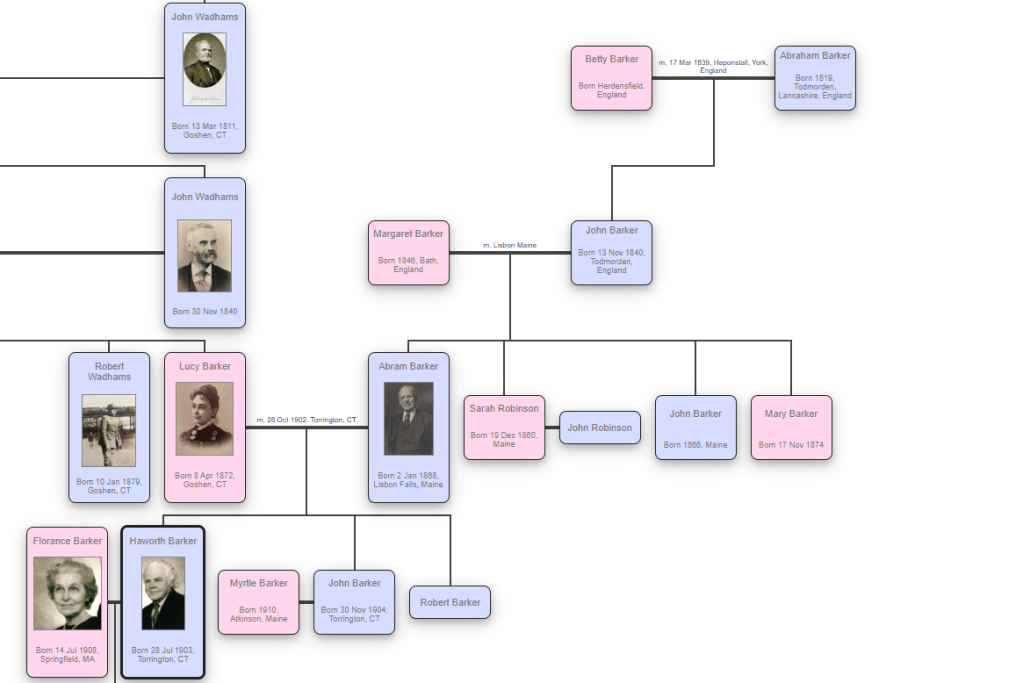
My Uncle Tony recalled that his grandmother, Lucy Burr Wadhams, thought of her husband [Abram Barker] as a “Johnny-come-lately” without the deep historical connection to America (and Goshen specifically) of her lineage.

Newcomers from England – John and Margaret Barker

My Uncle Tony mused that the family name was associated with a carnival barker, yet it seems more likely that the surname derived from OE “beorc” meaning to tan hides using tree bark, pointing to the occupational surname for tanners and bark-strippers.

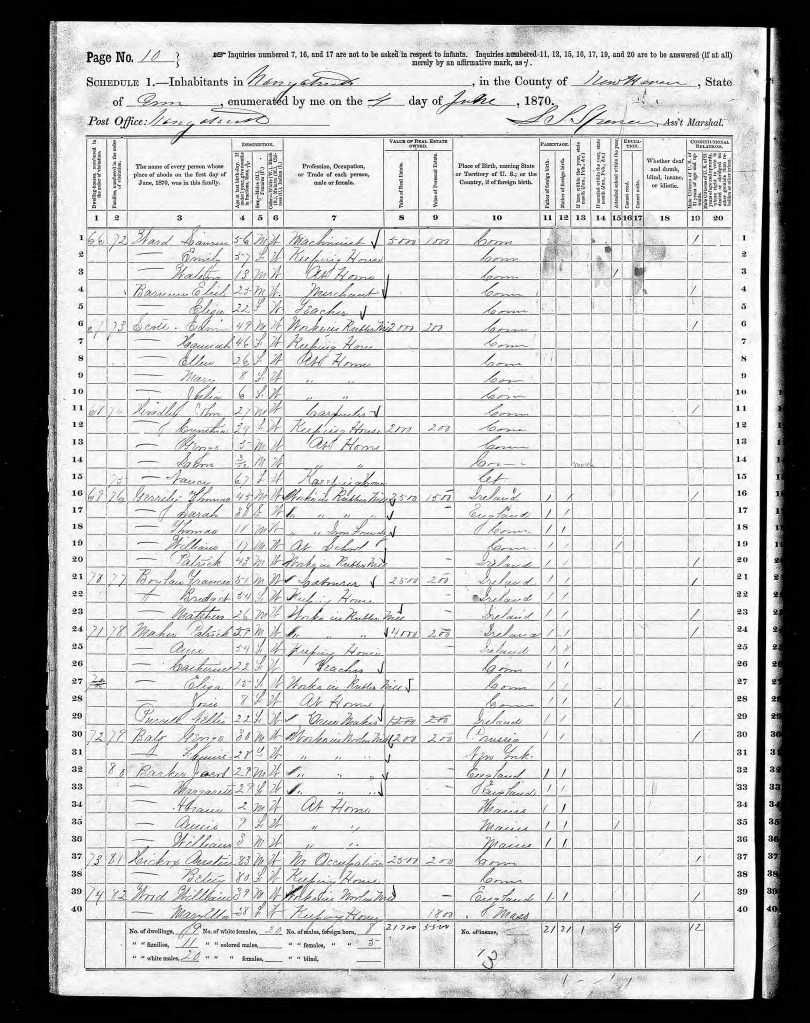
The Barker name is the most challenging part of my pedigree to trace – I can reliably only get back to my GGG-grandfather who was born and died in England. His son, John Barker emigrated from England for America, settling in Maine where my Great grandfather (Dr.) Abram Barker was born.

1870 Census (lines 32 to 38)

Todmorden, England appears to be the family omphalos. Geographically situated northeast of Manchester and southwest of Leeds. The parish records have not been fully digitized so I cannot find earlier marriage and birth records than Abraham and Betty.

While I can establish that the male line is rooted in the Todmorden/Calder Valley by early 1800s I have yet to trace it backward in parish and nonconformist registers to locate a prior county of origin. However, the Barker of Holbeach and Barker of Todmorden lines are separated by distance but not by implausible migration patterns.

There is no documented genealogical connection between the Todmorden Barkers and the Barker families of Holbeach or Great Steeping. They are simply geographic candidates.

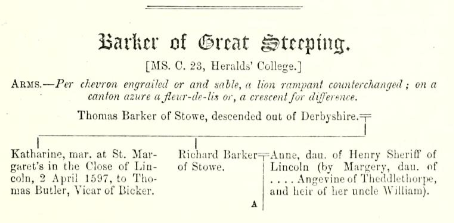
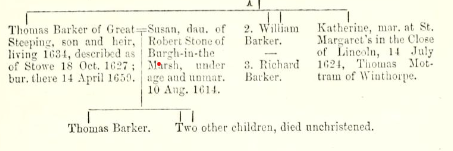
Arthur Roland Maddison (1843-1912) collected and edited the Lincolnshire Pedigrees and recorded the Barker line of Great Steeping:

pp 82-83

The Great Steeping pedigree’s statement of Derbyshire origin provides a credible bridge county. A two-generation relocation westward, fueled by trade, dissent, and industry, could plausibly produce the Todmorden line. Pending corroboration via parish and legal records, the linkage remains unproven but historically possible. However, there is no record of such a migration, and occupational Barkers are extremely common across the Midlands and North.

The Ogilby and Moll maps (1675–1724) show a continuous roadway linking Lincolnshire market towns to the Pennine valleys through Derbyshire. This east–west road system became the artery for craft and trade migration.

Great Steeping, 25 miles northeast of Holbeach, confirms that multiple Barker lines occupied the Lincolnshire fenland by the 17th century, one claiming descent from Derbyshire. This descent gives geographic plausibility to a Barker migration from the midlands into Todmorden’s textile region two centuries later. The Holbeach → Todmorden vector thus serves as the evidentiary spine for reconstructing a potential lineage, situating my ancestors within a realistic historical migration path.

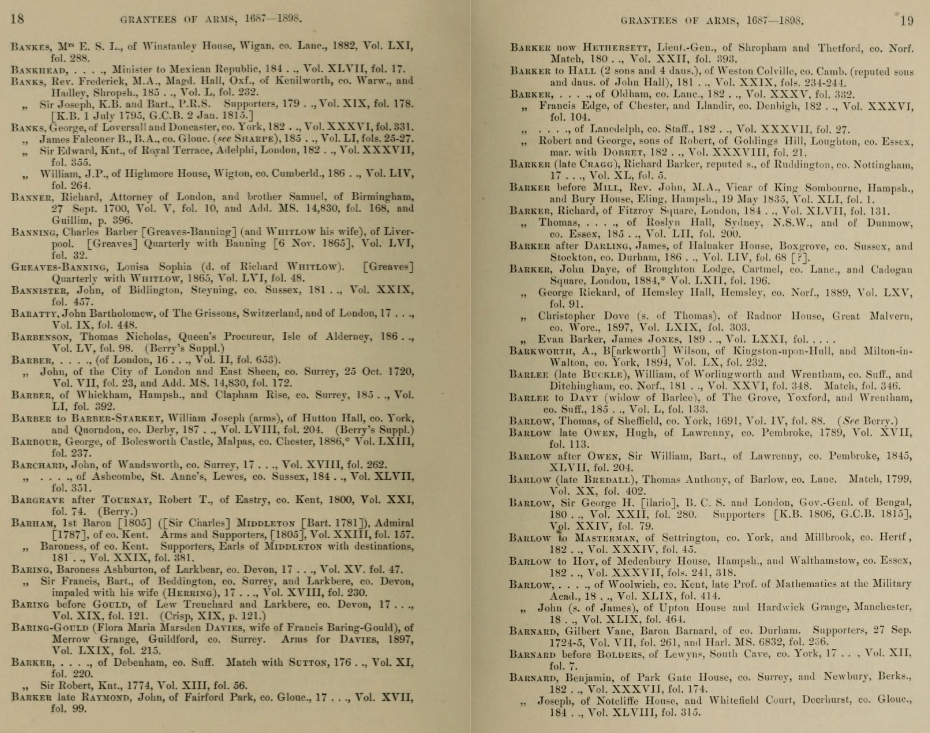
The Grantees of Arms lists several Barker lines

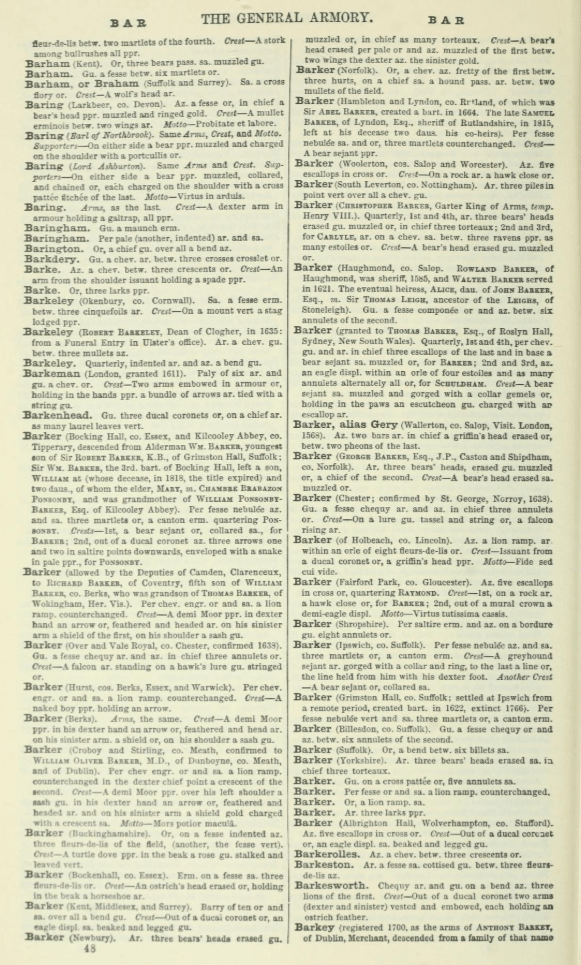
And Burke’s General Armory provides the blazon/motto citation:

My goal in researching the Barker lineage was to establish which crest should be used on signet rings which I planned as a family Christmas gift for each of us.

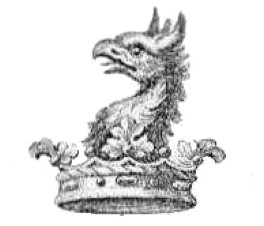
I cannot prove to be of an armigerous family with a coat-of-arms but as a convenience the Barkers of Holbeach appear to be the most geographically proximate lineage. And this was fortuitous. The crest is a griffin out of a ducal coronet and, more poignantly, the family motto is Fide Sed Cui Vide (Trust, but in whom take care) – a wonderful coincidence given my oft-used quip, “trust but verify!”

I take that coincidence as evidence of genetic disposition – thus providing provenance.

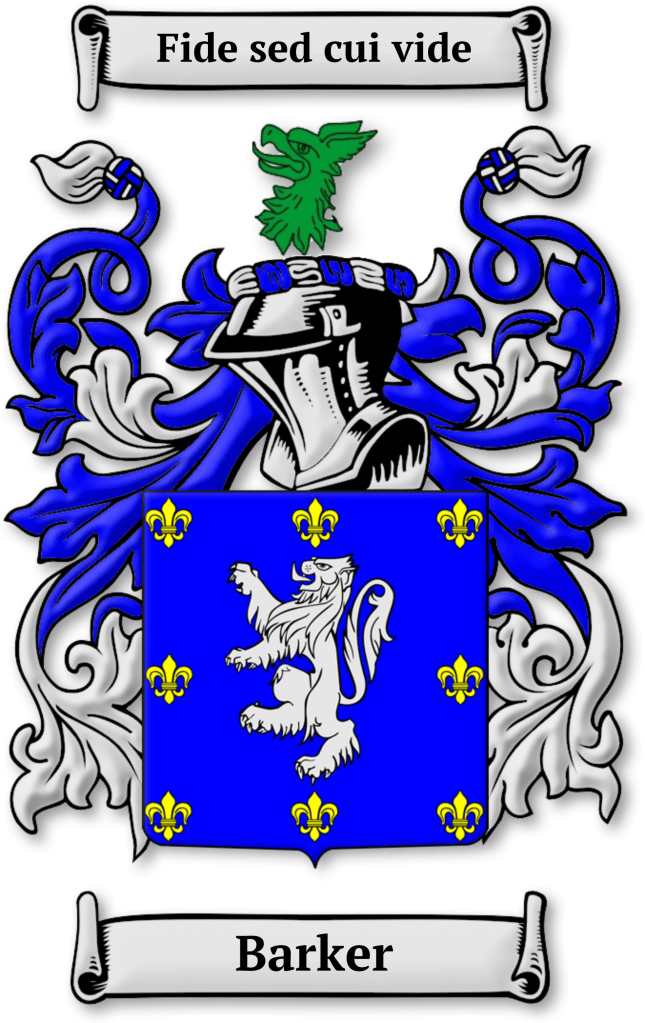
This particular image does not belong to any verifiable Barker lineage in the College of Arms, Lyon Court, or Ulster’s Office:

House of Names

It is a composite, commercial design made from: a Suffolk lion; a Kent/Lancashire fleur-de-lis motif; a modified Holbeach griffin, and the Holbeach motto. No single historical Barker family used this combination.

All this to justify the use of the griffin on a signet ring. A signet ring to evidence the bond we share as immediate family members.

And a longer connection to those ancestors (barely remembered) who preceded us. I hope my boys eventually find the ancestral connections meaningful.