Kihon waza are the developmental base forms and they show the correct way to train in order to allow for proper developmental growth in the art.
Normative words demand definition: what is a “correct” way to train and what is “proper” development?
I recall hearing a shihan once quip, “Aikido works. Yours doesn’t.” A pithy summation of what defines “correct:” a proper focus on efficacy. Thus, correct training inculcates the ability to deploy each technique so that your partner is controlled in a manner that harms neither your partner nor yourself.
Let’s unpack that.
First and foremost, this shit has got to work. Even a quick perusal of these posts will serve to illustrate that maxim. We are training in a martial art. Martial, relating to war and fighting, so Mars has etymological precedence.[1] As a fighting art, we must train for (1) economy of motion (2) maximum damage and (3) minimize vulnerabilities.
The problem to solve then is – how do we train to learn those principles?
This morning I attempted to demonstrate those principles by focusing on shihonage and uchi kaiten nage done from hanmi handachi.
Hanmi Handachi
Nage is in seiza and uke attacks while standing. As a Japanese art, the cultural context of a kneeling combatant makes perfect sense. From a tanren development perspective, suwariwaza is incredibly beneficial by hampering our ‘normal’ use of the lower body. To move effectively and with fluidity, nage must separate the upper and lower halves of the body.
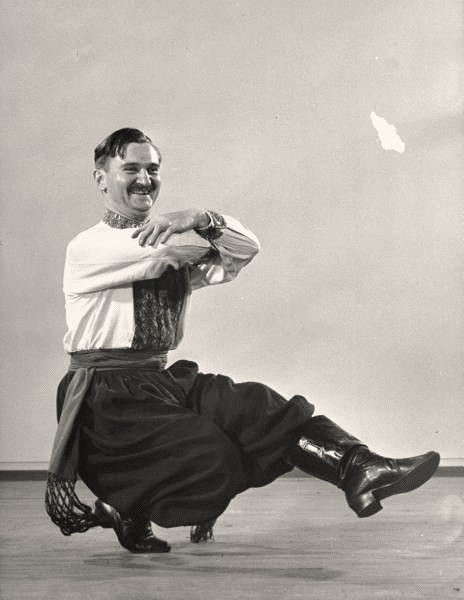
The metaphor of ‘integrated’ or ‘whole’ body movements at first seems to imply unified action – motion in a common direction. Nothing could be more misleading. The first key to integrated body movement is to distinguish the functions each half serves. Your upper body is your weapon platform, your lower body is the means of conveyance. Practice shikko at home, get used to squatting, then moving to your knees, then moving and returning to standing without use of your hands. These ways of using your lower body should free your upper carriage to move in different vectors at the same time (split coordination). The simple demonstration is to carry a sword in seigan no kamai while moving in shikko. The sword should not move from its center-line guard position despite moving in shikko which requires the hips to open side to side. A more robust demonstration (and one with a deep military tradition) is to watch Cossack [Turkic kazak “adventurer” or “free man”] dancers – or better still, try to emulate them! You must learn to keep the spine erect, the head balanced over your tanren, open the hip and move the legs without the familiar swinging action of the arms.[2]

It is precisely because suwariwaza is archaic that it is doubly beneficial – forcing we moderns to engage our lower half in an unfamiliar manner which leads to higher body awareness and develops lower body strength and flexibility.
For the pragmatist, hanmi handachi remains a valuable combative stance – it lowers your silhouette and adds stability. Just look at the estimable Jeff Cooper with his favored 1911.
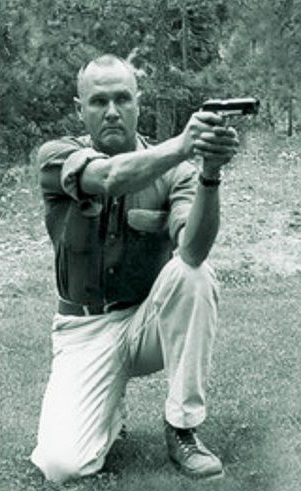
Modern combatives label this the Weaver stance. The Weaver stance is instantly recognizable to the Aikidoist as hanmi – the half stance that minimizes the target area on the vertical plane. Hanmi-handachi minimizes the profile on horizontal plane as well.
This photo also shows proper structural alignment. Col. Cooper aligns the web of the hand with the frame of the weapon with the elbow tucked down and in to use the shoulder as the connection point to the body. The body is ready for the recoil of the weapon discharge. Proper body alignment uses both the skeletal and muscular strength of the body to absorb the energy. Receiving uke’s attack from hanmi-handachi is similar.
As I have discussed elsewhere, uke grabs nage’s wrist because nage has a weapon. Therefore, uke must approach from the flank (not directly) and grabs with a forward energy. From the static kihon encounter, nage extends the arm with the fingers leading, nage’s elbow is bent slightly as if ready to do a forward roll (the ‘unbendable arm’), the tip of the elbow pointed at the forward hip bone. With good skeletal alignment, nage can receive a dramatic amount of force. The tanren development starts with this dynamic tension – uke weight down and forward, nage extension low to high and outward. The setup is between diametrically opposing vectors.
With tension established, nage then releases it suddenly and flowing the hand to the mat directly in front of nage’s centerline. Nage can augment the ‘invitation’ by using the free hand to touch uke’s inner elbow and accelerate the descending line. Nage then uses the free hand to grasp uke’s wrist and roll uke’s radius/ulna toward nage’s center whilst simultaneously extending the fingers of the grabbed hand rokyu-kokyu so the nage’s shyuto extends out (thumb comes toward nage’s navel) which creates opposing lines of force and will bone lock uke’s elbow. This is a momentary control nage exerts over uke and allows the extra ‘beat’ in time for nage to execute the next move. If as nage you do not control uke at this point – figure out the mechanics! The grabbed hand is pressing forward against uke’s fingers, using the small bones to control the larger bones (bone locking!).
Control established, nage must drive forward with the lower body – the arms have done their job so leave them alone. The inside leg now dictates the line (transverse the tangent of the circle)
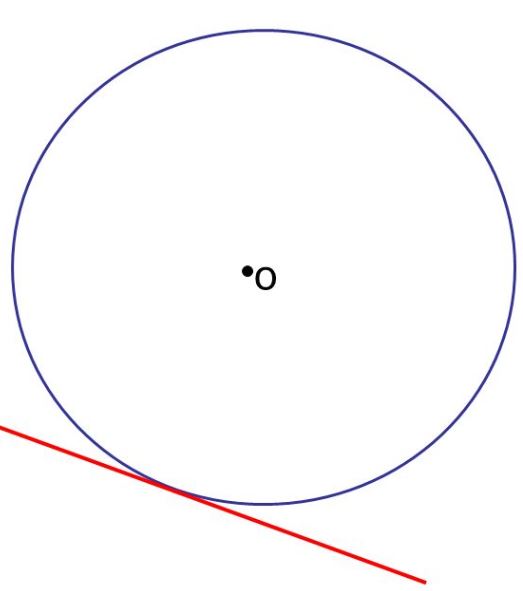
moves across uke’s front and because nage has control of uke’s arm, the act of moving forward necessitates that nage raise his arms just like raising a sword. In raising a sword, the kissaki moves first, thus all the lines of force originate at nage’s center (the bladder) and the primary muscles are those of the forward leg. The shoulder is a pivot point only – do not lift uke. Once successfully traversed – nage and uke are in a parallel relationship with nage’s hands directly above his head.
This is the next check point for nage. Do not disturb that relationship – your raised hands controlling uke’s arm is precisely what a raised sword in shomen no kamai should look like. Pivot swiftly under your sword. The inside knee drops to the ground, the hips snap 180-degrees, and the opposite knee rises. This entire action swivels under the raised hand (sword) which is in line with the spine.
The cut is now executed just like shomen uchi. Proper sequence here – weapon, hand, body, foot! Cut deliberately down toward your forward toe. Uke’s elbow is your kissaki – move that point first, then increase the strength of you hand grip, then as your arms break plane with your shoulders, slide your forward (raised) knee to uke’s arm pit.
The pin is now the priority. Nage’s toes are under uke’s armpit, nage’s knee leans in to compress uke’s ribs (patella toward uke’s chin). The old school pin would have nage keep both hands on uke’s wrist so that nage can press forward with the knee and pull back and up with the arm to destroy uke’s shoulder or elbow structure. The modern pin presses directly down on uke’s triceps so that uke’s humerus is parallel to uke’s head, the elbow is pressed toward the ground, and uke’s hips must raise (thereby rendering uke unable to weaponized the legs).
Nage must execute this sequence by the numbers – step by step – until the lines are precise and the hand- body work is precise. The vectors are scientific because dictated by human physiology – there is not an interpretive art here: it either works or it doesn’t. You either controlled your opponent or you didn’t. Aikido works. Learn to make it work, then find freedom of artistic expression within the form.
There is no ura – but if you lock uke’s elbow so tightly that uke begins to rotate behind you, then it makes no sense to move across uke’s front. Hence the only logical course of action is to rotate with and toward uke and cut down as described above.
What I hope to make clear is this: each step must be executed with mindful precision to make it effective. If you cannot execute each move so that an observer could snap a photograph that crystalizes the ideal form, then I suggest your Aikido does not work.
From Shiho Nage we moved to Uchi Kaiten Nage.
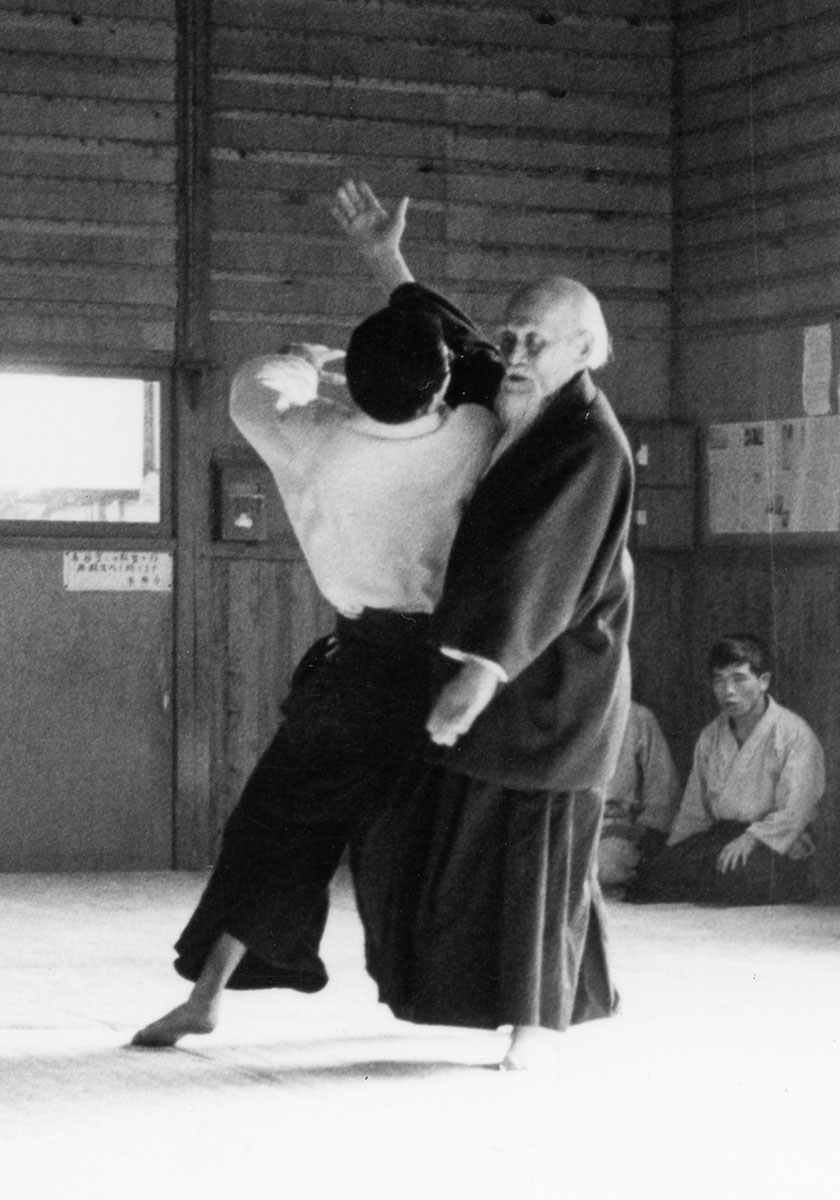
Uchi Kaiten is a beautiful double dagger technique. Uke grabs the first weapon hand that nage presents thumb up. Nage uses the grasped hand to cut uke’s lead leg (shin) which requires that nage flow from thumb up tension to the shyuto strike. Uke senses the attack and moves the leg which will pitch uke’s head down onto nage’s ascending second (back hand) weapon. In combat the encounter ended here – nage successfully made uke place his body on nage’s blade. Nage’s front hand strike is a C cut and the second (back hand) is an upward thrust through uke’s soft palate. Because the first strike removed uke’s leg, nage has created a low-gate opening. Advance through it! As you do, the grabbed hand raises on the vertical line (the C cut becomes more like a U), but leave the axis undisturbed. Pivot by snapping your hips and the knee-replacement sequence is the same as shiho nage. Once you have completed the 180-degree pivot, nage should hold the forward leg light (like nekko dachi).
The logic chain at this point should be for nage to execute shomen uchi with the goal to get uke to fall away (kokyu-nage), but because uke retains a grasp on nage’s cutting hand, nage must adapt and overcome. The lead leg snaps back (keep it available for a front kick) and the grabbed hand drops crisply to where nage’s toe just was. Uke by necessity pitches his head forward and low. With the free hand, nage cuts (or grabs) the nape of uke’s neck. From this control position, nage will now lock uke’s arm by barring it across the scapula and drive the knee into uke’s face.

If nage cannot execute a devastating knee strike (as in Muay Thai) then the form is wrong.
The line is dictated by the target. Nage must move the knee toward uke’s head – Aikido euphemistically calls this “controlling the center” but the pragmatist discerns what is required. Uke must move to avoid the strike. The alternative would be to compress uke’s neck and brace the arm across uke’s back – a shoulder dislocation. Either option needs be available to nage if uchi kaiten nage is to be deemed effective.
To be clear, nage must be in control of the encounter from the moment it begins. The outcome was dictated at the moment of first contact.
By executing the motions precisely, we learn economy of motion. Do nothing without purpose. Maximum damage is ensured by proper targeting: Know what you are hitting and why. If you are not executing a motion with the ability to strike a vulnerable area, then you are doing it wrong! Even a feint must be directed at a target.
With precise body and hand work, nage must close openings (tsuki) that uke could exploit. And here is the defining difference between Aikido and most other martial arts. Atemi (strikes) are used not to inflict maximum damage, but rather to close avenues.
The life-giving sword must be more skillful. We are training for the higher path where both nage and uke emerge with minimal physical damage. This requires great control. The strikes in Aikido must be as powerful and as effectively direct as any art, but Aikido uses the strike to direct uke’s attention and motion – to close openings in nage and create openings in uke.
Train in the proper use of (unarmed) strikes and learn weapon use. Train as if you have daggers in your hands and with ki-musubi (connected flow) and the path of least resistance will be made clear.
__________
[1] Mars (Roman) [Ares (Greek)] is the god of war and the ancients well knew the viciousness of battle. Ares personifies the raw violence and untamed aspects of war, and in great contrast with Athena whose wisdom provides strategy and tempers unbridled emotions. As brilliantly depicted in the Illiad, Ares is much maligned by the other gods, and even his father Zeus never spares him criticism. Ares was a formidable warrior, but the Greeks knew that mere bellicose skill was insufficient for the needs of the polis. At every instance, Athena bests Ares. The two gods quarrel during the Trojan War and in one scene Athena (by proxy through Diomedes) wounds him to remove him from the field of battle.
[2] The connection between dance and martial prowess is well established (review >Spotting<). However, as a postulate for others to prove/disprove, I would submit that those dances where the upper carriage is held isolated from the lower (Irish step dancing, Cossack, etc.) was originally a training method, similar in design to the Pyrrhic Dance (q.v. H. Michell Sparta) that mimicked battle moves – and involved springing up, crouching, thrusting, and spinning.

 Protective Arts