KI/KOKYUHO – internal power and its cognates

For this post, I amplify Master Keating’s thoughts and imbed links to make more clear what he was imparting. Study these concepts, they pertain to your Aikido training as well:

______________________

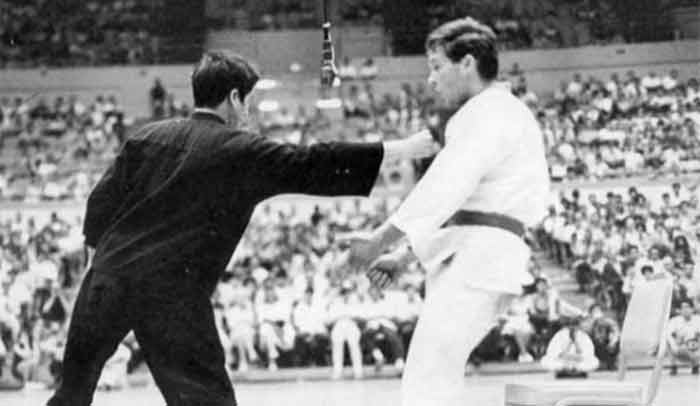
In Kung Fu to issue forth a blast of energy (force) from any place on your body is known as “Fa-jing“. It is what Bruce Lee employed in his now famous one inch punch demonstrations. It uses a quick-twitch muscle flex which in turn is based off of a “body-ripple” type action. The skeletal system delivers the force more so than the arm and hand. In this way the arm-hand merely act as struts, not pistons. Much like American football’s lethal (and banned) “stiff arm.”
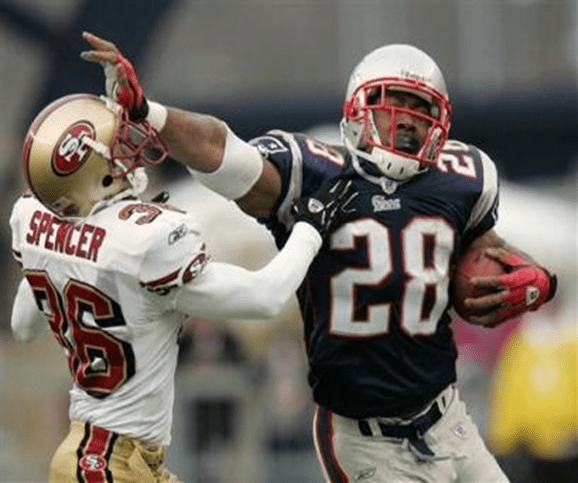
Banned for a reason

In another example Maestro Peter Urban (USAGOJU) named his version of Fa jing the “shock-shove punch” (and aptly titled it was)! If you have not felt fa jing type energy blows it is difficult to believe or understand. When you do experience such energy it is shocking and impressive. Theory swiftly becomes reality!

In Tai Chi there is a concept taught as “severing the root” – it is comprised of two opposite energies, push and pull. To sever the root is to shut down the opponents ability to respond-react. They sort of stall out mid-attack, it is then that you strike back. To pull this off you need the “listening energy” as is taught in some styles of kung fu. It receives, it does not oppose. You accept first, then you repulse. They enemy gets sprung violently between the opposing forces. The effect is done in perfect timing with their actions and reactions. If you cannot sense and read the energy of the person before you, you cannot pull off something such as severing the root. This is energy work at a high level, to practice under a good sifu who is willing to teach this level of combat awareness is a priceless find for they are few. Time, patience and determination will help you on this quest. Relax, let go of the rocks you are clinging to and let the current take you, go with the flow my friend –

Energy can go beyond the physical barriers. It can become a catalyst for certain intuitive feelings. This type of energy can be passed between people through the eye to eye contact. It can also be shot outward through the plexus chakra in a blast of psychic energy. In the Book of Five Rings Musashi calls this force “vigor”. He advises to “instill the vigor” from your feet right up to the top of the head. In the art of Tai Chi Chuan one is taught to keep the head erect, like it is floating above the shoulders. This is for the purpose of achieving the higher energy flow throughout the body for healing or for personal defense. There are many names for this energetic effect.

O’Sensei demonstrates

Each culture recognizes this energy, each giving it a name that best describes it in that particular country or culture. Chi, Ki, Pneuma, Prana, Vigor, Inner Fortitude, the list is long and going through it is pointless. Whatever name this energy is labeled it remains the same. Most of the time this energy and the command over it are deeply connected to the breathing processes and will power over the inner self. So regardless of whether we speak of the physical manifestation of it or the more aetheric psychic forms of energy one of the big tricks in dealing with energy is to possess the ability to control it. To have it at one’s beck and call is the ultimate goal, but t’is easier said than done. Such skills or gifts must be earned through long years of study and self discipline.

Since most people assume such talk as we pursue here is naught but sham and scam. It is an overlooked and misunderstood element in the vast pantheon of modern fighting and defense methods. It helps a bunch if you actually know someone who has this ability. They can show you (in person) something relating to tactical energy. To experience it is faith building in itself. It becomes a more “real” goal to pursue in your training regimen once you experience it.

Those people who can sense the energies of the opponent correctly can actually “read” the intent of their adversary. They seem to have a mysterious fore knowledge of the aggressors actions. Through the awareness of “exchanged energies” one becomes a most difficult subject to victimize. Counter and riposte become natural after a few years of cultivating such abilities. Kali, Kung Fu, Aikido and other arts share this trait in common. Each recognizes the flowing energies of the fight and touch pressures therein. Other arts are in complete denial of them. People bound by those arts will call such sensitivity training as I am speaking of as false and worthless. Hence the eternal struggle of the “haves and the have nots” in its most obvious form. Some arts and practitioners are so ignorant they don’t even know that they are that ignorant. Darkness and cultism unfortunately comprise a great deal of many martial arts styles and their underlying philosophies. Often what they lack in ability and skill they adequately compensate for through anger and sheer toughness

For you and I “energy” (NRG) is a word which describes the effects of a force or pressure that is felt in the practice of certain martial arts. In kung fu it has been described as a feeling similar to a “spring under tension”. It can also be used to define the lack of presence or “no energy” during an physical encounter. These forces or pressures are part of the close quarter combat experience. To be unfamiliar with them is to court disaster. To know of their ways, in other words to know the meanings of specific pressures is to have a big advantage over others. Awareness and sensitivity figure in heavily in the correct interpretation of these myriad pressures felt during a physical exchange. Anger and callousness run counter to this idea. Those sort of emotion based effects work to block one’s sensitivity to physical situations. They are lower based skills and appeal to those caught in the common conundrum of “what should I do” syndrome that normally occurs when violence strikes.  

_____________________________

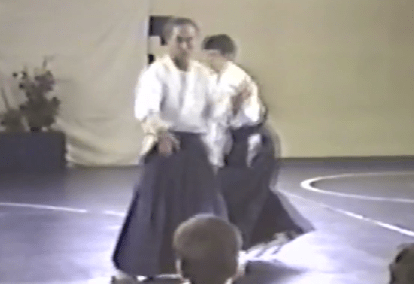
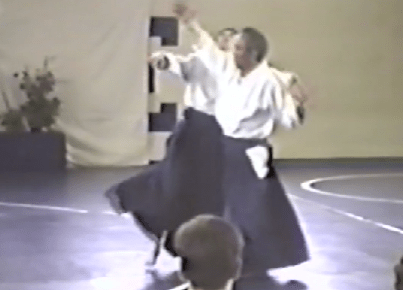
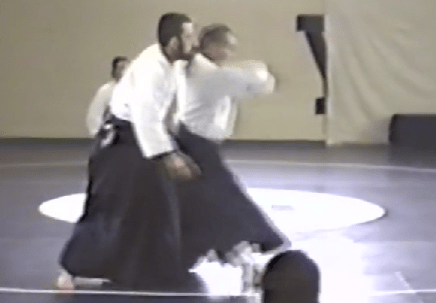
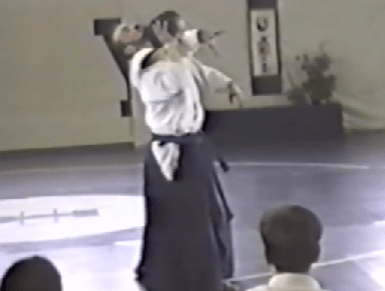
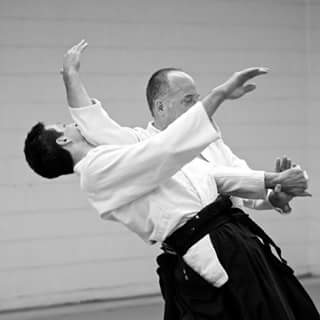
Please recognize the cognates here and learn to see kokyu as true power. Kokyu-ho as practiced is an intentional miss! Any application of kokyu is a powerful combat move, but as practiced in Aikido, it will seem to be more of a positional throw where the arm is used like a boom rather than a lance. Most Aikidoist are blind to the martial power in the art. Chiba sensei said the budo of Aikido is not at the surface.

Aikido’s essence as a budo is by no means close to the surface, but those with a degree of insight should be able to discern it. The aikido that we see on the surface, in other words, much of the aikido we see today, cannot necessarily be said to represent budo in the traditional sense of the word. Fortunately, in aikido there remains the potential for serious students to dig deep to discover its essence and through a long process of searching to make that essence their own. Aikido’s essence as a budo is by no means close to the surface, but those with a degree of insight should be able to discern it. The aikido that we see on the surface, in other words, much of the aikido we see today, cannot necessarily be said to represent budo in the traditional sense of the word. Fortunately, in aikido there remains the potential for serious students to dig deep to discover its essence and through a long process of searching to make that essence their own

So learn to look beyond the neutered presentation and perceive the application.
30656855_1718844028154080_8367292785979555840_n
Palm up is the friendlier version

_____________________________

Bonus – Chiba sense kokyuho variation
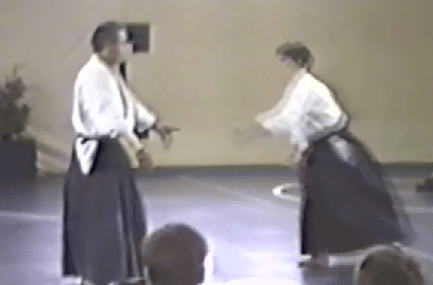
Start ai-hanmi
enter tenkan – shallow so as not to break contact
keep tension with grabbed hand and continue tenkan

This is the same turning entry as one does for tachi-dori, except unarmed, uke grabs.

The second variation, Chiba sensei slips under (as in uchi-kaiten) but notice the kokyu position:
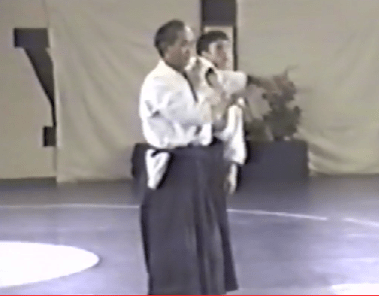
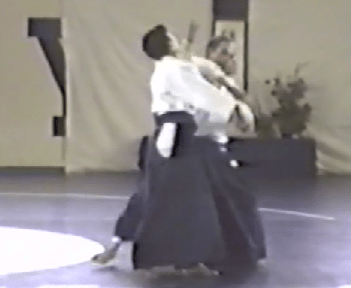
kokyu arm under uke’s grab-arm
(throw shown from opposite approach, not sequential photos)
of course he showed its bunkai as an elbow strike
he kept his grabbed hand high to keep uke chin-up

Better Angels

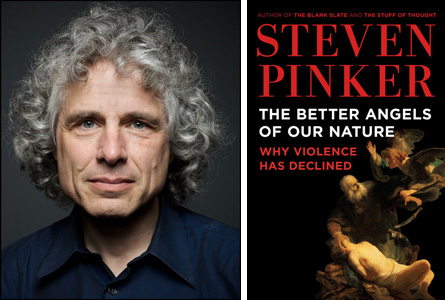
Uncle Jim pointed to a recent article in Science discussing Steven Pinker’s The Better Angels of Our Nature: Why Violence Has Declined (2011). I gave the book a quick read and found it a simple gloss on the benefits of global integration; hopeful homilies of an academician sheltered from the possibilities of violence. Pinker’s general thesis is that the overall rate of violence has decreased significantly over time indicating we are better, more civilized – hence the better Angels reference in the title. And while I admire his sentiment, Pinker’s reliance on big data disguises the most relevant aspects of violence (Nassim Taleb pointed out Pinker’s statistical errors). More importantly, like most academicians of the 1920s and 30s he falls to the arrogant guile of centralized power [1] which is best evidenced by his title, taken from Lincoln’s first inaugural address which betrays Pinker’s naïveté.[2]

Simply stated, Pinker observes that with the end of “the anarchy of hunting, gathering, and horticultural societies” and the rise of agriculture there was a reduction in violence.  Centralized authority leading to a reduction in violence? Better academics than I have already pointed out the terrible fallacy here.[3] And I find it ironic (given Pinker’s earlier work on language) that he so baldly shows his prejudice in describing hunting and gathering societies as living in “anarchy.” Without a doubt agriculture lead to an increase in population which allowed (some claim necessitated) centralized authority which then leads to a monopoly on violence. So we have traded raiding for war and vengeance for state sanctioned murder. The scale has changed, but the principle behind the violence has not. We have not become our better Angels, we have just become subjugated. I am not hypocritical enough to ignore the fact that I personally enjoy the benefits of centralized power, but I am too aware of history to naively believe it isn’t simultaneously the greatest threat to our freedom (and the increase in the disparities in wealth).[4]

The fact that we are all statistically far more likely to die in an automobile accident than we are in an act of raw violence is mistaking correlation for causation.[5] Most of us are insulated against direct violence and protected from it by experts in its use. The massively integrated global economy has definite benefits that are increasingly raising the living standards for most of the globe. Combine the overall increase in the standards of living with the amazing decline in the percentage of the population directly involved in food production and the result is passive complacency. Passive because most of us are not directly responsible for our daily survival – we have all traded our varied skills for money which mediates our need to produce for ourselves. Food is no longer a mere necessity for survival but rather a celebratory social engagement. And I am thankful for it! But I am not blind to the fragility of the arrangement.

Having grown up around small-scale farms I remember what it is all too convenient to forget: that most of our protein is provided only after the jugular is slit. Pinker agonizing over torturing a rat as a psychology student is admirably pathetic.  Admirable in its sentiment, pathetic in demonstrating how disconnected we are from providing for ourselves. Humans are killers because it is necessary to kill to eat. (Even you vegetarians are destroying life to survive.) That is a basic fact for our species. Modernization can disguise and bury it with specialization and insulate us from it and Pinker misses this ugly truth.

Sitting in a comfortable Harvard office reviewing statistics compiled by others, it is easy to see the macro-trends in the overall decline in death resulting from war as a percentage of the population. His observation is an inane one because he ignores the means of violence. At its core, to kill another human is an intimate interaction. Freud had that right.

We are not, as a species, evolved to be the better angels that big data suggests. Our nature is defined by our responses in crisis. It is precisely the deviations from the mean that we need to address. The fact that most of us will not experience a direct threat to our survival, that most of us will not be subjected to violence, and we no longer need hunt for our larder doesn’t mean that human nature has changed. The need for violence will always be present because violence is the only means to remove a mortal threat. The fact that modern social structures have made wage-slaves of most of us just shows that we willing subjugate ourselves for a modicum of security.

But in the statistical margins we see the persistence of human nature: Buddhist perpetrating genocide on Rohingya, Muslim jihadist extremism, CIA black sites… Violence remains pervasive and is not limited to any religion, culture or time. It remains a persistent human trait. And that fact gnaws on us. The Walking Dead is a brilliant reminder that we are our own worst enemies. Zombies aren’t the threat because zombies have no volition.

So while I am enthusiastic for Pinker’s optimism and revel in the comfort and safety that the modern world provides me, I hold no illusions that our better angels will prevail. History and current events prove otherwise.

It may be relegated to the margins, to the aberrations in the data set, but violence remains real and – impolite as it is to write this: necessary. Necessary because the only counter for violence is superior violence.

Much like table manners had a profound civilizing effect, the cultivation of martial skill civilizes violence. And it is precisely martial skill that we need to understand. Not just the technical “how to” or even the cultural differences “like this” but the more critical understanding of “why?”

The greatest and earliest examples of deep psychology are teaching texts: Gilgamesh and Illiad. Gilgamesh’s transformation after meeting and helping civilize Enkidu and later, his mourning Enkidu’s death and his subsequent quest for immortality shows the higher path. But his quest is fraught with violence. Achilles’ great anger is succored only when he and Priam share the experience of loss. These men did not become great because of their ability to commit violent acts, but because they came to understand violence and its proper use. Violence staves off death and provides the foundation for the edifices of civilization. The life preserving sword. We moderns too easily forget that fact.

Our aspirations to transcend our nature are admirable. The idea of violence as a means of effecting power is trite and a deep study in the martial arts should teach us to become truly better as individuals and that is a personal responsibility.

_________________________

[1] To my thinking, Lewis Mumford’s The Myth of the Machine is a far more subtle and insightful read. Mumford is aware of the benefits and dangers of Leviathan.

[2] Examine the origin of Pinker’s title. Lincoln’s first inaugural address given on the eve of the greatest sacrifice of American blood by the State. The entire speech is a justification for violence perpetrated by a central authority but with clever rhetoric shifting the blame to the polis (Pericles would have been proud to have authored this!) – read the concluding paragraphs (the emphasis is Lincoln’s):

In your hands, my dissatisfied fellow-countrymen, and not in mine, is the momentous issue of civil war. The Government will not assail you. You can have no conflict without being yourselves the aggressors. You have no oath registered in heaven to destroy the Government, while I shall have the most solemn one to “preserve, protect, and defend it.”

I am loath to close. We are not enemies, but friends. We must not be enemies. Though passion may have strained it must not break our bonds of affection. The mystic chords of memory, stretching from every battlefield and patriot grave to every living heart and hearthstone all over this broad land, will yet swell the chorus of the Union, when again touched, as surely they will be, by the better angels of our nature.

Thus wars are begun, with the swelling pride of patriots fighting for a Union. Look at the rhetorical flourishes hiding embedded lies (The government will not assail you! Balderdash: mandatory conscription forced many on the battlefield). Our motives may have become more abstracted – fighting for the preservation of the Union and only later the abolition of slavery – but I am not convinced that dying for an abstraction is nobler than fighting over hunting territory. And in the final analysis, the violence remains.

[3] The most frightful omission is the possible impact of a nuclear exchange. Briefly a distant potential, but now one that could dramatically change the statistics of death. A black swan event indeed! Review the links at the bottom of this post.

Perhaps a simple means of reviewing what Pinker is fascinated by. The Economist graphs both the general decline but highlights the important aberrations:

Democracy.png
Economist November 10th, 2018

Note the observation, “The countries most prone to wars appear to be neither autocracies nor full democracies, but rather countries in between.” Tease apart that observation and look deeper in time. I am reminded of the Peloponnesian War and those grave conflicts where the largest spikes in death from protracted conflict have been democratic causes. The demos swayed by demagogues resulting in wars like no other (Hanson, 2005).

And this recent post by Tyler Cowen reviewing Only the Dead: The Persistence of War in the Modern Age, by Bear F. Braumoeller, which is largely a critique of Pinker on trends toward peacefulness (Pinker gives only the more optimistic data on Europe). And from the text:

…there is variation in the rate of conflict and war initiation over time, and it’s pretty substantial. Leaving aside the two jumps during the World Wars, the median rate of conflict initiation quadruples in the period between 1815 and the end of the Cold War, after which it abruptly drops by more than half.

The “falling rate of conflict” is thus not entirely reassuring.

How about the deadliness of occurring conflicts?

Analyzing the two most commonly used measures of the deadliness of war, I find no significant change in war’s lethality.  If anything, the data indicate a very modest increase in lethality, but that increase could very easily be due to chance…Worse still, the data are consistent with a process by which only random chance prevents small wars from escalating into very, very big ones.

Overall, the arguments in this book are strong, and the discussion of data issues is subtle throughout.

And one massively important variable that has reduced the lethality of combat is medical technology.

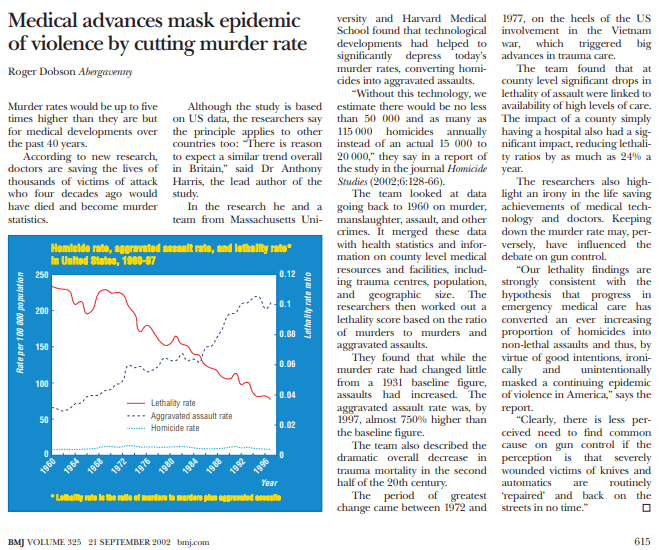
The National Library of Medicine indexed an older (2002) article published in the British Medical Journal.

The article examined long-term trends in violent injury and homicide and the conclusion is sobering in its simplicity: a significant portion of the modern decline in homicide rates is not the result of reduced violent behavior, but of dramatically improved survival rates following violent acts. Advances in emergency response, antibiotics, blood transfusion, vascular repair, and neurological care have radically altered the probability that an assault results in death. What would once have been fatal now often resolves as an injury.

This matters because homicide statistics are commonly treated as a proxy for moral progress. They are not. They are downstream of medical capacity.

Administrative categories record mechanisms and outcomes, not counterfactuals. A stabbing that would have been fatal in 1850 but is survivable in 2025 is no longer counted as a homicide. The violent intent remains; the victim simply survives it. If modern trauma systems were removed the statistics would change overnight without any corresponding alteration in human psychology or social norms.

This is not a pedantic distinction. It goes to the heart of Pinker’s causal claim. A reduction in lethality is not the same thing as a reduction in violence, and neither is proof of moral transformation. It is proof of technological interposition: modern societies have become safer largely because violence has been buffered, managed, and medically mediated, not because it has been transcended.

This helps explain the confidence of modern elites. We live doubly insulated lives. Protected first by institutions that monopolize violence on our behalf, and second by medical systems that erase its consequences before we ever see them. From such a vantage point it is easy to mistake safety for goodness, and survival for virtue.

I admire Pinker’s optimism. I enjoy the world his data describes. I benefit from it daily. But optimism becomes dangerous when it forgets the conditions that make it possible. Institutions that suppress violence are among humanity’s greatest achievements. Right up until they fail. History suggests they always do.

Human nature is not revealed in averages or trend lines. It is revealed under stress, scarcity, and collapse. In those moments, the same patterns reassert themselves with depressing regularity.

Violence remains impolite to discuss. It remains uncomfortable to acknowledge. And it remains, in extremis, necessary. The only durable counter to violence has ever been superior violence, disciplined by restraint, tradition, and understanding.

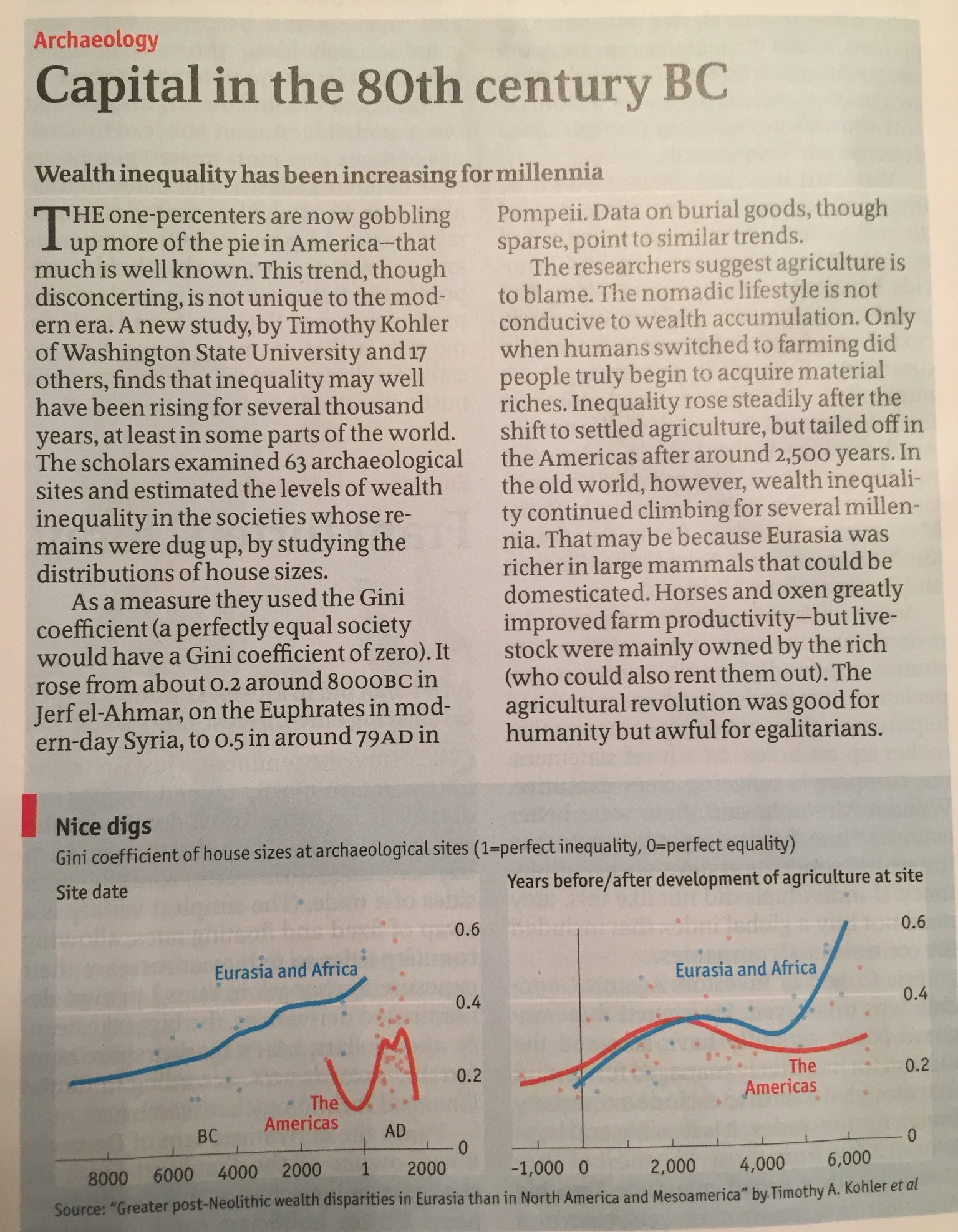
[4]  Wealth inequality through time from The Economist  – note that while agriculture improved the overall standards of living that there is a trade-off in disparity.

[5]  A controversial but statistically convincing explanation for the recent decrease in violence in the United States is the legalization of abortion (Donohue and Levitt 2001).  Summaries: Stephen Levitt and Steve Dubner on Freakonomics, and criticisms, and the counterpoint. The underlying logic – those children who would have been unwanted or burdensome to parents unwilling or unable to raise a well-adjusted human are never born and therefore never get to cause predatory violence.

_________________________

UPDATE

The November/December 2019 issue of Foreign Affairs “War is Not Over: What the Optimists Get Wrong About Conflict” is a summary of the nature of geopolitical conflict and has a sobering admonishment:

Above all, overconfidence about the decline of war may lead states to underestimate how dangerously and quickly any clashes can escalate, with potentially disastrous consequences. It would not be the first time: the European powers that started World War I all set out to wage limited preventive wars, only to be locked into a regional conflagration. In fact, as the historian A. J. P. Taylor observed, “every war between Great Powers . . . started as a preventive war, not a war of conquest.”

BACK TO BASICS

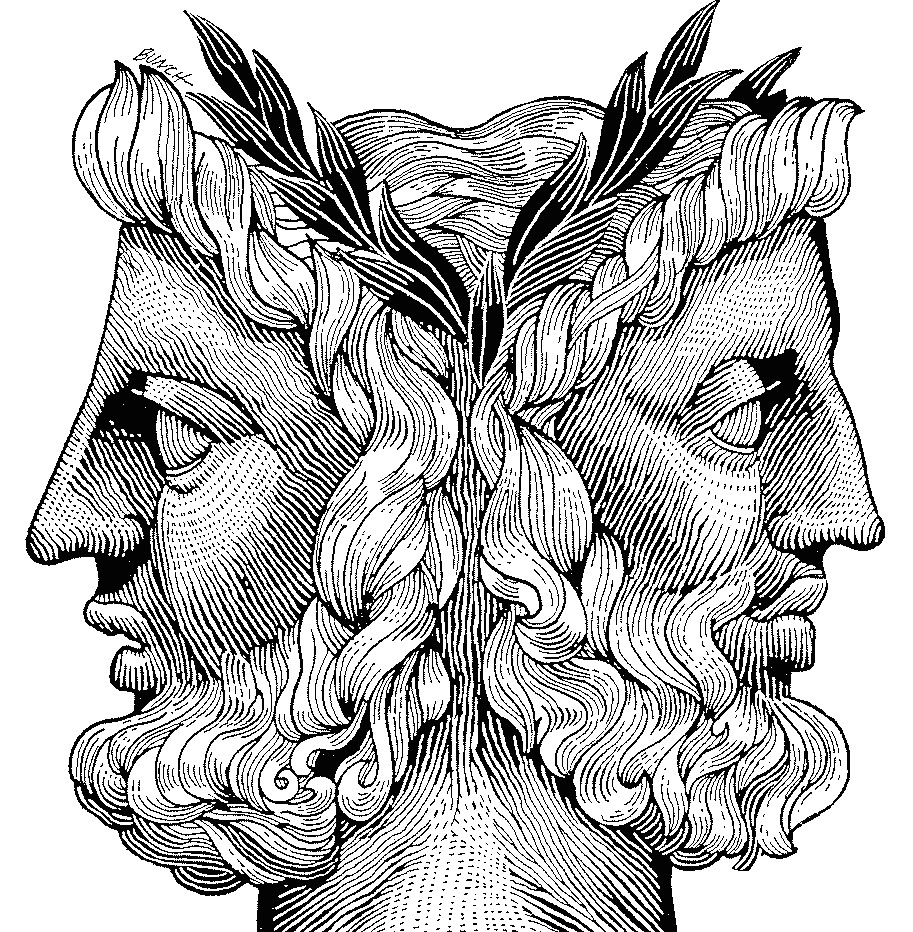
Janus again as a featured image to symbolize the start of a new year and for 2018 I will embark on a new experiment.  For the past two years, I have been focusing of teaching concepts rather than techniques (re-visit the beginning) in order to train the trainers.  For this New Year I will systematically go through the basic kihon of the Aikido curriculum.  I hope to still elucidate concepts – or at least help make connections – through teaching the techniques but the direction of the pedagogical thread will be inverted. 

Why?  I want to ensure a systematic presentation of the curriculum and focus on teaching to the test (rather than training the trainers).  The USAF Aikido standard testing requirements will define the curriculum.  I will cover all the techniques required for shodan (1st degree black belt).  Please make a study of the USAF test Matrix (which also includes Hombu dojo’s) as well as the requirement sheet.

There are a total of 29 discrete techniques required for 1st kyu which jumps to a minimum presentation of 35 for shodan in the USAF Requirements.  For comparison, at Hombu 31 are required for 1st kyu but at shodan the requirements cover “all forms.”  However, look at the time requirement for days of practice:  In Japan the time commitment necessary to achieve shodan is less than half that in the United States.

Remember – the reason for the difference is primarily cultural.  Meaning, shodan in Japan is clearly understood as demarking the start of training, the beginning of real learning and refinement; whereas in the United States shodan often denotes the beginning of teaching.  My goal is to clearly impart the curriculum in a clear and concise manner so as to build a solid foundation for efficient training, genuine understanding, and future refinement.

Let us be clear.  Teaching to the test is nothing more than a quick way to show how to replicate the basic responses.  I do not believe that this is the best way to impart understanding.  I do however think it is necessary to ensure that the framework for future learning is solid.  And testing is an important aspect of training in Aikido.

The total number of techniques is small when you recognize that there really isn’t a significant difference in the execution of the movement (the response) when done from different positions (modes) – i.e., from standing, both sitting, and only nage seated (and omote and ura forms).  In a list form, the number of techniques looks more intimidating than it should be:

Katatetori Shihonage (omote & ura)

Katatetori Nikyo (omote & ura)

Hanmi handachi: Katatetori Shihonage (omote & ura)

166452_181509391887559_3677227_n

Katatetori Kaitennage (uchi & soto mawari)


Morotetori Kokyunage (omote & ura)

Morotetori Nikyo (omote & ura)

Morotetori Iriminage (2 variations)

Morotetori – 5 Techniques


Tsuki Iriminage (irimi, tenkan & tenshin variations)

Tsuki Kotegaeshi (tenkan)

Tsuki Kaitennage (omote & ura


Ryotetori Tenchinage (omote & ura)

Ryotetori – 5 Techniques


Koshinage – 5 Techniques


Katatori Nikyo (omote & ura)

Katatori Sankyo (omote & ura)

Katatori Menuchi – 5 Techniques


Ushiro Tekubitori Kotegaeshi (omote & ura)

Ushiro Tekubitori Shihonage (omote & ura)

Ushiro Kubishime Koshinage (2 variations)

Ushiro Tekubitori Jujinage (omote & ura)

Ushiro Tekubitori Sankyo (omote & ura)


Ushiro Ryokatatori Kotegaeshi (omote & ura)

Ushiro Ryokatatori Sankyo (omote & ura)


Hanmi handachi: Ushiro waza – 5 Techniques


Shomenuchi Ikkyo (omote & ura)

Shomenuchi Iriminage

Shomenuchi Nikyo (omote & ura)

Shomenuchi Ikkyo (omote & ura

Shomenuchi Sankyo (omote & ura)

Suwari waza: Shomenuchi Iriminage Shomenuchi Nikyo (omote & ura)

Shomenuchi Shihonage (omote & ura)

Shomenuchi Kaitennage (omote & ura)

Hanmi handachi: Shomenuchi Iriminage

Shomenuchi – 5 Techniques


Yokomenuchi Shihonage (omote & ura)

Yokomenuchi Iriminage (3 variations)

Yokomenuchi Kotegaeshi (omote & ura)

Yokomenuchi Gokyo (omote & ura)

Yokomenuchi Kotegaeshi (omote & ura)

Yokomenuchi – 5 Techniques

If you take the time to break each attack and response into a collective matrix, the number of possible combinations are impressive and I would point you to Stefan Stenudd’s well-thought compilations.  Another good mental frame work would be the list here

Ultimately, these frameworks that create discrete boxes and if-then style thinking need to transform into an organic logic-chain – in other words, techniques need to be reduced back to concepts.  Nevertheless, because focusing on the connections without a clear understanding of the discrete elements is challenging – back to the basic pedagogy for a while.  

____________

[For those who want a quick video-reference reminder – one could do no better than to review Tissier’s lessons.]